Katy Dartford enjoys some early season skiing, where before the crowds arrive she finds snow that holds and plenty of space to ski properly in the high altitude French resort.
Skiing in mid-December in Tignes feels like arriving just as the place is waking up. It’s not quite off-season, but the town hasn’t fully rubbed the sleep from its eyes either.
 The lifts are running, the glacier is open and race crews are already busy across the valley, but the mountain itself hasn’t gone into full performance mode yet.
That can be a risky moment in winter. Early-season skiing is often a compromise: limited terrain, thin cover and a fair amount of optimism. But on this first-tracks trip to Tignes, it doesn’t feel like that at all. Off-piste is understandably best left alone, but the pistes are well covered, properly groomed and made for flowing turns. Add bright sunshine and space, and it feels like exactly what’s needed after weeks of November rain.
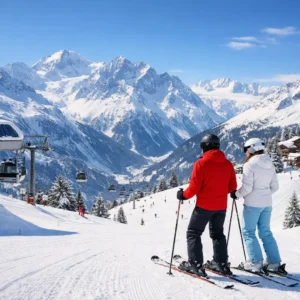
There are no big queues, no lift-gate scrums, just a steady glide away from the station and straight into skiing. The air is sharp, the snow underfoot firm and dry, and instead of fighting for space, you can actually get some laps in. This is early-season skiing for people who want to ski.
 First runs, trees and a flooded village
Our first run drops through one of the few more tree-lined sections of the mountain, the terrain rolling gently away towards the lake below. It’s a good warm-up for legs that haven’t slid on snow since spring. We stop partway down and look out across the water.
Margot Sella, our instructor, points towards the lake and explains why it’s there. In the 1950s, the original village of Tignes was destroyed to make way for a hydroelectric dam. Families were forced to leave, salvaging doors, windows and even stones from their homes before the valley was flooded. When the water is drained today, the foundations of the old village still appear. You can still see where people lived.
There’s now a virtual-reality experience at the Maison de Tignes that explores this history, taking visitors through the flooded village, the dam and the rebuilding of the resort higher up the mountain.
Lower villages and family skiing
From above, the layout of the resort makes sense. Tignes 1800 sits lower and more sheltered, with learner areas and gentler terrain that suits families. Les Brévières, lower still, is quieter again, with tree-lined runs and a village atmosphere that feels calmer than the higher bases.
Margot is straightforward about it. These are villages for families, beginners and people who want space. If nightlife matters, they’re not the places to stay. That’s a useful contrast to Val Claret, higher and colder, where December days feel shorter because the sun drops early and the temperature follows quickly once it’s gone.
 Why Tignes works so early
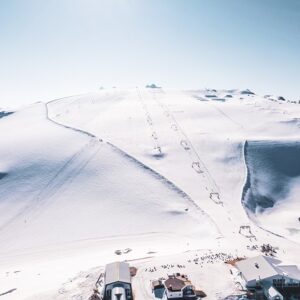
At 3,456 metres, the Grande Motte glacier underpins Tignes’ early-season reliability. The Glacier Express gondola does the climb in around five minutes, delivering you straight into high-altitude terrain where snow quality holds even when lower resorts are still waiting for coverage.
Margot explains that this is why people come to Tignes so early in the season. Not because everything is open, but because what is open tends to ski well.
Up here, the snow feels firm and grippy rather than intimidating – the kind that lets you get your legs back without constantly worrying about what’s underneath you. Margot points out that days like this aren’t guaranteed so early in winter. Visibility on the glacier is often limited. Today, though, it’s clear enough to take in wide views across the Vanoise, with the Italian side of Monte Bianco visible off to one side.
The glacier, then and now
The glacier has long been central to Tignes’ identity. In the 1960s, it was famous for year-round skiing, with summer lifts and drag systems stretching across the ice.

That era has ended. Most of the old lifts have been removed, with only one remaining, as there is no longer enough snow to maintain pylons safely through summer.
Margot doesn’t dress it up. In summer now, she says, it’s ice and rocks. July skiing isn’t good anymore. The glacier still does its job in winter, but nobody pretends it’s untouched by warming temperatures.
New lifts, better flow
Recent investment in Tignes has focused on upgrading lifts rather than expanding terrain, and the difference is felt quickly. The new six-seater L’Aiguille Percée chairlift is the standout this season, running at up to six metres per second and carrying around 2,800 skiers an hour. It improves access to one of the resort’s most recognisable sectors and smooths the link between Tignes le Lac and Les Brévières.

Elsewhere, beginner areas are being reworked. Around the Palais sector, Margot explains that this is where the resort is trying to improve things for first-timers, acknowledging that Val Claret has never been the easiest place to learn. Conveyor belts are replacing older drag lifts, and longer-term plans include improved access around the Club Med area.
When we reach Palais, she’s quick to add that it isn’t only about beginners. From the Merles lift, she says, there’s good off-piste when conditions allow.
Empty runs and December quirks
With World Cup racing taking place over in Val d’Isère, much of the Tignes side feels unusually quiet. The Johan Clarey black, often busy later in the season, is almost empty, with long views stretching across towards Italy and Mont Blanc.
Shaded pistes hold their snow well, while sunnier aspects soften briefly before losing the light altogether. In December, the days feel compressed. In Val Claret, the sun drops early and the temperature follows fast. The rhythm becomes simple: ski hard, eat late, and suddenly it’s dark.
 From the chairlift, Margot points out a small opening in the rock opposite, known locally as the “mouse hole”. Then she gestures to something much more obvious on the skyline: L’Aiguille Percée, the pierced rock formation that gives the lift its name. Also known as the Eye of the Needle, it entered modern ski folklore after Candide Thovex skied clean through it in a viral clip.
Locals, Margot says, have their own nickname for the darker, colder side of this sector. They call it Mordor, a reference to The Lord of the Rings, a place where the sun disappears fast and December really feels like winter.
A quick hop into Val d’Isère
The link across to Val d’Isère is open, so we cross briefly to catch the World Cup slalom. From Tignes, it’s a familiar sequence of lifts, finishing on the Olympique téléphérique, where you can look straight down over the course.
From above, the slope looks brutally steep, the rhythm aggressive and unrelenting as racers attack the fall line. On the lift, the conversation drifts to Downhill Racer, which feels appropriate as we watch skiers throw themselves downhill at full speed.
 Margot is clear that the two resorts play different roles. Val d’Isère feels more village-like, with more trees, bigger chalets and a stronger focus on racing. Tignes, by contrast, is higher, more functional and more obviously built around skiing rather than scenery. They’re not competitors, she stresses, but complements.
Together, the wider Tignes–Val d’Isère area is vast, with around 80 per cent classified as off-piste, even if early season means choosing lines carefully. After watching the racing, we ski piste M opposite the course. It’s completely empty, with wide views dropping away towards the lake and dam below, before heading back to Tignes as the light fades.
When the skis come off
At the end of the day, there’s still energy left. In Val Claret, Cocorico is busy without being packed, with room to move and the right level of early-season atmosphere. The manager, Callum Smale, jokes about French laws that mean if you’re the last person to serve someone a drink, you’re responsible for them. He’s been in resort for a decade, previously managing in Val d’Isère, and admits it’s not all glamour. He’s just finished fixing the toilets, which still involve bringing loo roll in from outside the cubicle and coping without a seat.
 Adventure, then cheese
The following afternoon brings something new: electric snow e-karting in Val Claret. It’s go-karting on snow, fully electric, with very little noise beyond laughter and the occasional shout. The briefing is minimal: no contact, don’t get out of the kart, and use the blue button to reverse if needed.
We do a few familiarisation laps, then race. I lead early, get overconfident, drive straight into a snow bank and have to be pulled out. I finish near last.
Next door, also new this season, is a winter adventure park with rope courses and nets strung above the snow, aimed at families who want something more active than sledging.
Later, there’s a cheese tasting at the local cooperative, comparing Beaufort summer and winter. The winter version is sharper and more intense. The cheese is made in Bourg-Saint-Maurice, with milk from cows that graze on the same slopes we’ve been skiing on.
Early season in Tignes isn’t about having everything. It’s about having enough: snow that holds, lifts that work, space to ski properly, and villages that know who they’re for. Before the crowds arrive and the calendar fills up, the mountain feels open and workable. For skiers who want to move, explore and get laps in, it’s a very good time to be here.
TRAVEL FACTS
- Katy stayed at Hôtel Le Taos
- Restaurants in the area include Drôle d’endroit, Le Bollin, Cocorico, Kodo bar, Alberto, Chez Juliane
- You can book an E-Buggy through Evolution 2
- Enjoy cheese tasting with Coopérative Laitière de Haute Tarentaise