You notice it most in the lift queue. Twenty years ago, helmets were far from universal on European slopes. Now, in many resorts, they are the norm for children, common for adults and almost standard among snowboarders. That shift did not happen because helmets became fashionable. It happened because more people asked a very practical question: are ski helmets worth it when you weigh comfort, cost and real-world protection on the mountain?
For most skiers and snowboarders, the honest answer is yes. Not because a helmet makes you invincible, and not because it replaces sensible decision-making, but because it offers meaningful protection in exactly the sort of incidents that happen every season – unexpected collisions, low-speed falls, hidden ice patches, crowded home runs and those awkward moments near lifts, park features or narrow pistes.
That said, there is a difference between saying helmets are worth it and pretending they solve every safety problem in snow sports. Good advice starts with that distinction.
Are ski helmets worth it for most people?
In simple terms, yes. A modern snow sports helmet is designed to reduce the force of some impacts to the head. That matters because not every crash is dramatic. Plenty of injuries happen in very ordinary circumstances, particularly when conditions are firm, visibility is flat or a rider catches an edge at the wrong moment.
The key point is that mountain injuries are not limited to experts skiing fast in exposed terrain. Beginners fall. Intermediates get tired late in the day. Strong skiers make mistakes in busy areas. Snowboarders spend plenty of time on their heels and backsides, which can make backward falls especially relevant. A helmet cannot stop every concussion or serious head injury, but it can lower the risk and reduce the severity of certain impacts.
That is why the question has largely moved on from whether helmets are only for racers or children. In the modern ski area, they make sense for almost everyone on snow.
What a ski helmet actually does
A helmet works by managing impact energy. The hard outer shell helps spread force across a wider area, while the foam liner compresses to absorb part of the blow. In practical terms, that means your head is less exposed to a direct hit against hard snow, ice, a rail, a tree branch or another skier’s shoulder or ski.
This is most useful in common incidents rather than extreme ones. Catch an edge on scraped-off snow and fall sideways. Clip someone in a congested funnel. Slip while skating to the chair. Those are exactly the kind of moments where a helmet can make a bad day less bad.
It also adds some protection from incidental knocks that are easy to dismiss until they happen. Chairlift bars, ski racks, car doors in icy car parks and low beams in mountain restaurants are hardly glamorous threats, but they are real enough over the course of a week away.
Where helmets help less than people assume
This is where the conversation needs a bit of realism. Helmets are not magic. They do not protect your neck, spine, knees, wrists or shoulders. They do not guarantee that you will avoid concussion. They do not make high-speed tree skiing, icy red runs in a white-out or park riding beyond your ability suddenly safe.
There is also a tendency among some riders to think of a helmet as a licence to push harder. That is the wrong lesson. The mountain still punishes poor judgement, fatigue and overconfidence. If anything, wearing a helmet should sit alongside better habits – controlling speed, skiing within sight lines, respecting slower traffic and knowing when the legs have gone.
In other words, helmets reduce risk. They do not remove it.
The strongest argument for wearing one
The best case for helmets is not built on fear. It is built on probability.
Most skiers and snowboarders are not deciding between wearing a helmet and hurling themselves down a World Cup piste. They are deciding whether a relatively light, comfortable piece of kit is worth bringing for a week in the Alps, a few days in Scotland or regular sessions at the dry slope or indoor snow centre. When you frame it that way, the trade-off becomes much clearer.
A decent helmet is now comfortable, well ventilated and easy to wear with goggles. It lasts for years if cared for properly and not damaged. Compared with the overall cost of a ski holiday, lift pass, travel, clothing and equipment, it is hardly the biggest outlay. For something that may help in a genuine accident, that is a fairly persuasive equation.
For families, the answer is even clearer. Children fall more often, have less awareness of their surroundings and are still learning slope etiquette. Most parents would not think twice.
Comfort, style and the old objections
Some objections linger from an earlier era of snow sports equipment. Older helmets could feel bulky, sweaty and awkward with goggles. That is much less true now.
Modern designs are lighter, warmer without being stifling and generally much better integrated with eyewear. Adjustable fit systems, removable ear pads and effective venting have improved matters hugely. If a helmet feels uncomfortable today, it is often because it is the wrong shape or size rather than because helmets are inherently unpleasant.
Style was another sticking point years ago. That argument has largely faded. On most slopes, a helmet no longer marks you out as cautious or inexperienced. If anything, turning up without one can feel more unusual, particularly in bigger resorts and among stronger riders.
The remaining issue is communication and hearing. Some skiers dislike the slightly muffled feeling around the ears. That is fair, and fit matters here too. But most helmets are designed to preserve enough hearing for normal slope awareness, and the adjustment period is usually short.
Are ski helmets worth it if you ski carefully?
This is one of the more common questions, especially from experienced skiers who pride themselves on control and piste awareness.
The trouble is that skiing carefully does not mean skiing alone. Even if your own technique is sound, you cannot control every other person on the hill, nor can you predict every patch of refrozen snow, every sudden pile-up at a junction or every late-afternoon lapse in concentration. Many crashes involve another person, and many solo falls happen at modest speeds when balance, terrain or visibility changes unexpectedly.
Good skiers are not exempt from ordinary accidents. In some cases, confidence and mileage simply expose them to more hours on snow, and therefore more opportunities for something to go wrong. Careful skiing is excellent risk management. It is not complete protection.
Choosing a helmet that is actually worth wearing
A helmet only earns its keep if it fits properly. Too loose and it can shift in a fall. Too tight and you will hate wearing it by lunchtime.
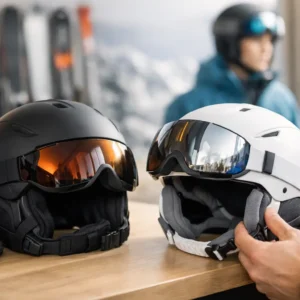
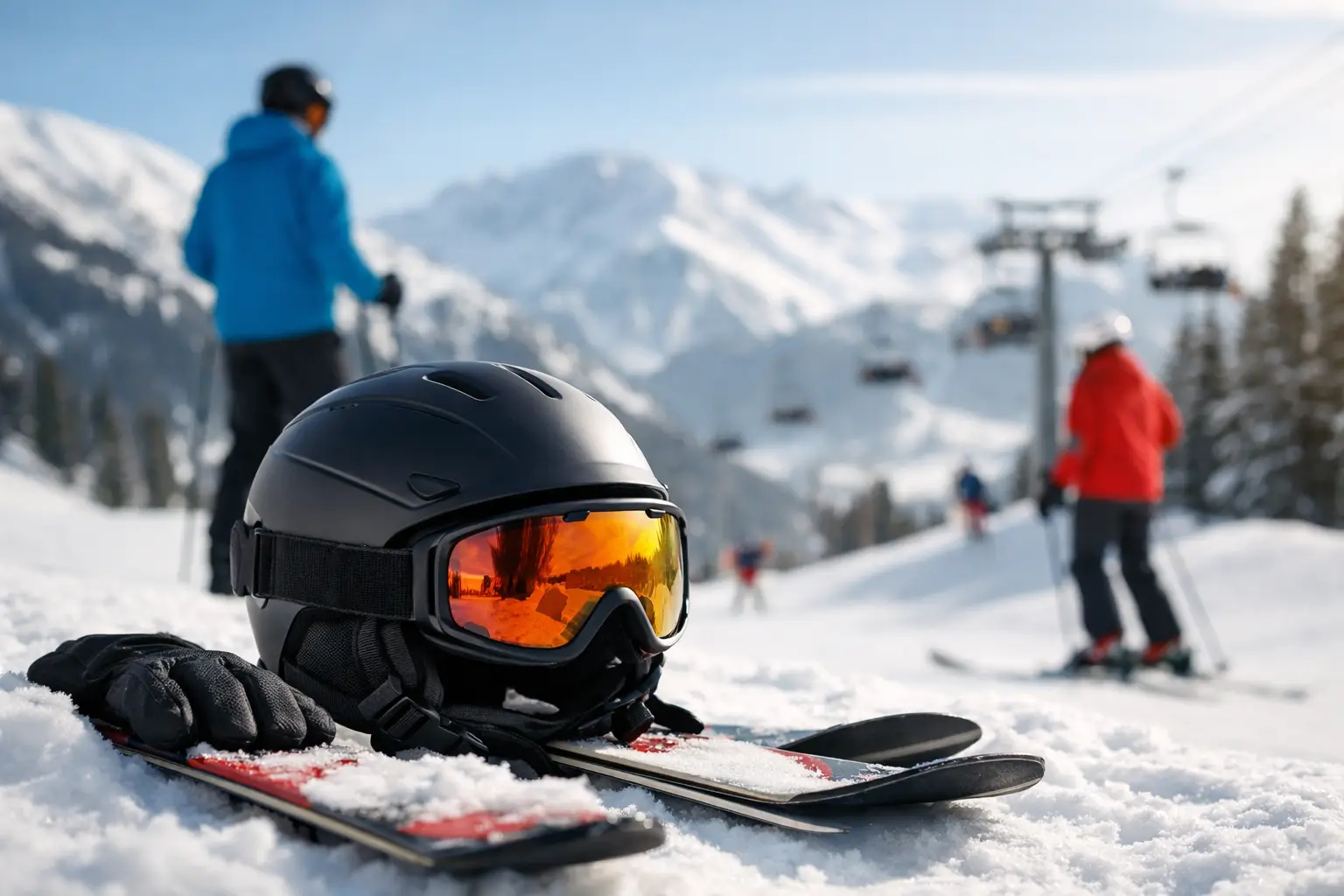
The fit should be snug all the way round your head without painful pressure points. It should sit low enough on the forehead to protect properly, and it should work cleanly with your goggles so there is no awkward gap or pushing at the frame. Try it on with the goggles you expect to use if possible.
Look for recognised safety certification, but do not get seduced by marketing jargon alone. Fancy technology can be a bonus, but fit, condition and correct use matter more than showroom buzzwords. Ventilation, warmth and adjustability all count because the best helmet is the one you will wear all day without fiddling with it.
One more point often missed: replace a helmet after a significant impact, even if damage is not obvious. The protective foam is designed to absorb force, and once it has done that job, it may not perform properly again.
The case for renters and occasional skiers
If you only ski once a year, you might wonder whether hiring a helmet is enough. Often, it is. Rental helmets are vastly better than no helmet at all, and many shops now carry decent, modern stock.
Still, frequent skiers and snowboarders will usually be better off owning one. Personal fit is better, hygiene is better, and you know the helmet’s history. For UK riders doing an annual Alps trip plus a few indoor sessions, ownership quickly starts to make sense.
That is especially true if you care about comfort. The more natural a helmet feels, the less likely you are to leave it in the chalet on day three because the weather looks mild.
So, are ski helmets worth it?
For the overwhelming majority of skiers and snowboarders, yes. They are worth it because the risks they address are not rare, dramatic outliers. They are part of normal mountain life. Helmets will not turn poor choices into good ones, and they are not a substitute for technique, awareness or restraint. But as a practical piece of protective kit, they are one of the easiest good decisions you can make before stepping onto snow.
In a sport where conditions change by the hour and other people are part of the equation, that small margin of added protection is worth taking seriously. Wear one that fits properly, replace it when it has taken a real knock, and then get on with the enjoyable part – skiing and riding well.