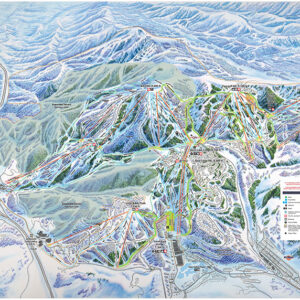
You only need to end up on the wrong side of a mountain once to realise how useful piste maps really are. A run that looked like a gentle cruise from the village can turn into a long red cat-track, a slow chair in the shade, or a final lift you miss by ten minutes. If you want to know how to read piste maps in a way that actually helps on snow, the trick is to see them as planning tools rather than pretty resort artwork.
Most skiers and snowboarders glance at the colours, find the main gondola and move on. That is enough until the weather closes in, your legs go, or the group splits between beginners, confident intermediates and the one friend who always wants “just one more black”. A good reading of the map saves time, avoids unnecessary stress and helps you make better calls through the day.
How to read piste maps before you clip in
The best time to read a piste map is not halfway up your first chair. Study it over breakfast or while waiting for the lift to open. Start with the resort’s shape. Is it one broad bowl above a compact village, or a linked area spread across several valleys? That single point changes everything, from where you warm up to how much margin you need to get home.
Look first for base villages, key lift hubs and obvious bottlenecks. If a resort has several sectors linked by one or two major lifts, those lifts matter more than any individual piste. Miss one, and your day shrinks quickly. In large French domains this is common, but it applies just as much in Austria, Italy and Switzerland where valleys, ridgelines and weather exposure can create natural choke points.
Then check altitude. A piste map is not a contour map in the strict sense, but the numbers tell a story. A village at 1,200m with skiing up to 2,800m usually means a long vertical, changing snow quality and potentially different weather between top and bottom. Early in the season, the lower return runs may be thin or slushy by afternoon. In poor visibility, the highest lifts may be the first to close.
The symbols matter more than people think
Colours are only one layer. To read a piste map properly, you need to decode the lift system as carefully as the runs themselves. Gondolas, cable cars, funiculars, chairlifts and drag lifts all move people differently, and that affects how smoothly your day runs.
A fast gondola from the village can be your reliable morning route when temperatures are low and queues are manageable. A long drag lift on a windy ridge may be fine for skiers but less appealing for many snowboarders, especially if it is the only access to a sector. Beginners often focus on green and blue runs, but if the only way into that zone is a button lift, that is worth knowing in advance.
Pay attention to whether lifts are marked as high-speed or standard. On a big map, two chairlifts can look equivalent when one takes six minutes and the other takes fifteen. That difference changes how much terrain you can cover, and whether a route is realistic before lunch.
Other symbols are just as useful. Snowparks, boardercross areas, beginner zones, ski routes, toboggan runs and lift-pass boundaries all appear on many resort maps. So do avalanche-controlled itineraries in some areas. These are not simply decorative extras. They tell you who a sector is really for and whether it matches the day you want.
Run colours are a guide, not a universal law
This is where plenty of holiday planning goes wrong. Blue, red and black grading is helpful, but it is not standardised with scientific precision across every resort and country. A red in one area may feel like an easy cruiser. A red somewhere else may be narrow, busy and steep enough to feel nearly black when scraped off by 2pm.
That matters especially for British skiers and snowboarders choosing terrain by confidence level. A map tells you the official grade, but not always the character of the piste. Is it consistently steep or just one short pitch? Is it wide enough to let nervous skiers take their time? Is it a key return route filled with traffic at the end of the day?
The same caution applies to greens. In some resorts, greens are true beginner nursery runs. In others, they can be long, flat roads that are awkward for snowboarders and tiring for first-week skiers. If you are guiding a mixed-ability group, look at where the greens and blues sit in relation to the main lifts and lunch spots, not just whether they exist.
How to spot the awkward bits of a resort
Good piste-map reading is often about identifying what could catch you out. Flat sections are one of the biggest examples. Artists make maps look flowing and graceful, but some connecting pistes are really long traverses. Snowboarders end up unstrapping and pushing, while skiers wonder why they have lost momentum three times in one run.
Watch for tracks that snake across a face rather than fall directly down it. They often indicate a road-like link run. If a supposedly easy route back to the village meanders for miles, it may be simple technically but draining late in the day.
Also note where terrain funnels. If several pistes merge above one narrow home run, expect congestion in the afternoon. If one chairlift serves every attractive red in a sector, queues may build quickly in peak weeks. Resort maps cannot show traffic levels minute by minute, but they do reveal where pressure naturally gathers.
South-facing versus north-facing slopes can matter too, even if the map does not spell it out. Use the general orientation of the mountain and the position of the sun. South-facing lower runs may soften fast in spring. North-facing sectors often preserve better snow but can stay colder, firmer and flatter in light.
Planning routes with real-world logic
The smartest way to use a piste map is to build routes around energy, weather and lift timing. Early in the day, many skiers head straight for the obvious flagship sector. Sometimes that makes sense. Sometimes it means joining everyone else in the same queue while quieter lifts spin half empty nearby.
Look for natural circuits. A good circuit keeps you moving through lifts and pistes without repeated backtracking. The best resorts reward this approach. You spend less time traversing and more time skiing or riding terrain that suits your level.
Also think about your return route before you leave an area. This sounds obvious, yet it is where groups get stranded or stressed. If the route home depends on one cable car or a sequence of lifts, leave a margin. Weather, queues and tired legs can turn a straightforward return into a scramble.
This is even more important in linked ski areas where crossing from one valley to another feels easy at 11am and much less clever at 3.30pm. The map usually shows the links clearly if you know what you are looking for. Any narrow chain of lifts or traverses between sectors deserves extra attention.
Paper map, app or lift-board?
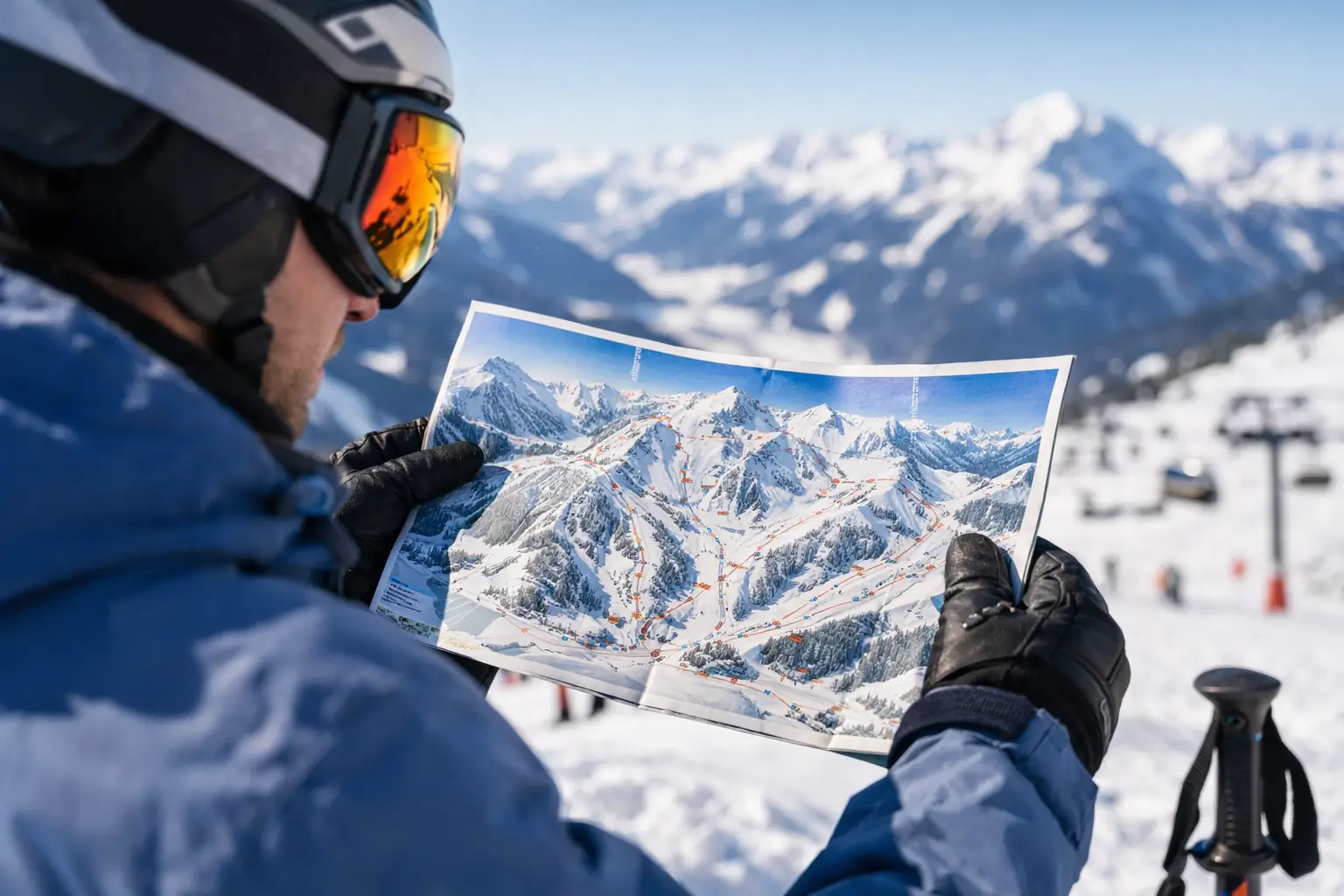
It depends on the resort and your style. Printed piste maps still do one thing brilliantly: they show the whole mountain at once. That makes them better for understanding terrain flow and planning a day. Mobile apps are stronger for live lift status, GPS location and alerts, especially when visibility is poor or unfamiliar sectors start to blur together.
The trade-off is simple. Apps are dynamic but can tempt you into staring at a screen in the middle of a ski day. Paper maps are clearer for the big picture but do not update when wind shuts a ridge chair. The sensible approach is to use both. Read the whole area on paper or on a full-screen map first, then use your mobile for live changes if needed.
Lift-base boards are useful too, but they are usually tactical rather than strategic. They help confirm what is open right now. They rarely replace a proper understanding of the resort layout.
Common mistakes when learning how to read piste maps
The biggest mistake is assuming the shortest visual route is the fastest or easiest. It often is not. A direct line may hide a black pitch, a drag lift or a slow bottleneck. Another common error is focusing only on the run down and ignoring the lift back up. On a powder day, that may not matter. On a family holiday or a mixed snowboard-ski trip, it absolutely does.
People also underestimate how different a resort feels in bad weather. In sunshine, a broad high bowl looks inviting. In flat light, the same terrain can feel featureless and tiring. Piste maps help here if you identify treelined sectors and lower-altitude alternatives in advance.
Finally, do not assume every marked route is right for your group just because it is open. Open means available, not necessarily enjoyable. A long red return at the end of the day can turn a strong morning into a poor finish for less confident skiers.
At Skier & Snowboarder, we have always found that the best mountain days start with knowing the lay of the land. A piste map will not tell you everything about snow texture, crowds or the mood of a stormy afternoon, but it gives you the framework to make smarter decisions. Read it well, and the mountain feels bigger in the right way – full of options, not surprises.