The first untouched line beyond the ropes can be one of the best moments of a ski holiday. It can also be where the assumptions made on the lift – that fresh snow means safe snow, or that other tracks prove a slope is fine – become genuinely dangerous. This guide to avalanche safety is for skiers and snowboarders who want to make better choices when the resort boundary, touring route or sidecountry gate is in view.
Avalanche awareness is not about making every powder day feel intimidating. It is about understanding that mountains are changeable environments, and that good decisions begin long before anyone clicks into bindings. For most UK visitors heading to the Alps, Pyrenees, Scandinavia or North America, the most useful skill is knowing when to stay on managed terrain, when to hire a qualified guide and when the conditions simply do not stack up.
A guide to avalanche safety starts before the lift
An avalanche forecast is not a green or red light. It is a detailed picture of where the problems are most likely to sit, how easy they are to trigger and what the consequences could be. Read it each morning, then match it to the terrain you are considering. Pay close attention to aspect, altitude and the stated avalanche problems, rather than focusing only on the headline danger level.
A moderate danger rating can still produce serious avalanches on particular slopes. Equally, a high rating does not mean every marked piste is off limits. Resort teams manage pistes through forecasting, control work, closures and patrols, but those measures do not extend to every appealing patch of snow beyond the boundary. Follow closures without argument: they are there because professionals with local knowledge have identified a risk.
Weather tells the rest of the story. Fresh snow, strong wind and a rapid rise in temperature are classic warning signs, especially in combination. Wind can transport snow onto sheltered slopes and build deceptively deep slabs, while sunshine can quickly change the stability of snow on certain aspects. A cold, clear spell after snowfall may look settled from the terrace, yet a weak layer lower in the snowpack can remain a concern for days or weeks.
Ask a local professional what has changed. Ski school teams, mountain guides, lift staff and patrol services often have a sharper sense of recent wind loading, snowpack behaviour and terrain traps than a visitor checking an app over breakfast. Their advice should shape the day, not merely confirm a plan already made.
Read terrain, not just snow conditions
Most slab avalanches release on slopes roughly 30 to 45 degrees steep. That does not mean a slope needs to look like a cliff to be serious. Many broad, inviting powder faces sit squarely in that range, and rollover features can hide the steepest section from view.
Terrain also determines the consequences. A small slide above rocks, gullies, trees, cliffs or a stream bed can be far more dangerous than a larger release that runs into an open, forgiving basin. Gullies deserve particular respect: they collect snow, funnel debris and make escape difficult. The same applies to slopes above road cuts, pistes and popular traverses, where people below may be exposed even if they are not skiing the slope themselves.
Look for clues, but do not mistake them for certainty. Recent avalanche debris, shooting cracks around skis or board, and a hollow “whumpf” from the snowpack are immediate reasons to move away from avalanche terrain. Tracks are not evidence of stability. A slope may have held several riders before the next person finds the weak point, particularly around convex rollovers and thinner snow near rocks.
Good groups avoid placing everyone in the same hazard at once. If a slope has been assessed as appropriate to ski, cross exposed sections one at a time, watch each other from a safe position and agree where the next person will stop. This is not about military-style formality. It is the practical habit that means somebody can see what has happened and respond if a slide occurs.
The essential avalanche kit – and what it cannot do
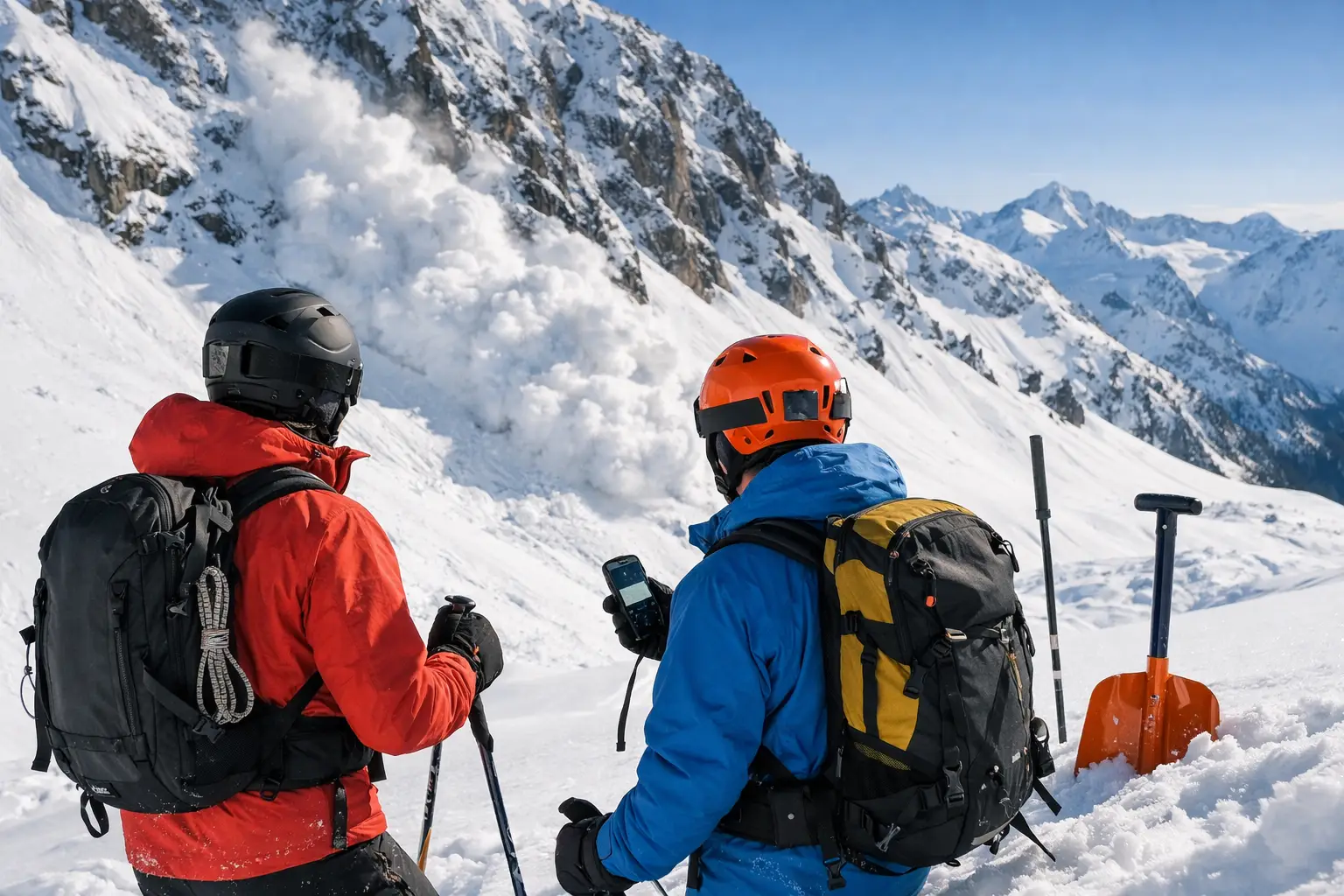
Anyone deliberately entering unmanaged avalanche terrain should carry a transceiver, probe and shovel, and know how to use all three. An avalanche airbag can add a margin of protection in some avalanche types and terrain, but it is not a substitute for judgement or companion rescue skills.
Your core kit should include:
- A modern digital avalanche transceiver, worn correctly beneath your outer layers and checked with the group before setting off.
- A proper probe, long enough for winter mountain use, not a lightweight improvised alternative.
- A metal-bladed shovel with a practical handle, because fast, efficient digging matters enormously in a rescue.
- A charged mobile phone, local emergency numbers, an offline map and enough warm layers, food and water for an unplanned wait.
Carrying equipment without regular practice creates false confidence. Transceiver searches are stressful, physical and time-critical; probing and shovelling take longer than most people expect. Book a recognised avalanche education course before a touring holiday, and refresh those skills at the start of each season. Many guides and ski schools run short introductory sessions, but a single afternoon does not turn a group into independent backcountry travellers. Treat training as an ongoing part of the sport.
Before leaving the lift system or trailhead, carry out a transceiver check. Confirm every device can transmit and receive, agree the route, identify no-go terrain and make sure everyone understands the plan. If one member lacks the equipment, experience or appetite for the objective, change the objective. Leaving somebody behind while the rest of the group chases a line is rarely a good answer.
Group decisions are often the real hazard
Avalanche incidents are not only about snow science. Familiarity with a favourite run, excitement after a storm, pressure to make a guidebook line worthwhile and the desire not to disappoint friends can all push a group towards poor choices. These are normal human reactions, which is why they need to be discussed openly.
Set an easy standard: anyone can call for a rethink, without having to win an argument. A quieter skier, a less experienced snowboarder or the person who has spotted a worrying sign may be seeing the situation most clearly. The strongest group is not the one that always gets the first tracks. It is the one that can turn around without embarrassment.
Keep plans modest when conditions are uncertain. Lower-angle terrain, well-spaced trees where appropriate, and routes with fewer overhead hazards can still provide excellent skiing and riding. The trade-off is obvious: you may miss the dramatic face seen from the chairlift. In return, you preserve options for the rest of the holiday and reduce the chance that a single decision defines it for the wrong reason.
Alcohol and fatigue matter too. A long lunch, a hard previous day or a late-afternoon rush for one final lap all reduce the quality of decisions. Build in time to get back before lifts close, temperatures fall and light flattens. Navigation mistakes become far more consequential once a group is tired and off the planned route.
If an avalanche happens
If a slope releases, try to move out of the path if there is an immediate escape line. If caught, discard poles and try to stay on the surface, but do not rely on any single survival tactic. The priority for companions who are safe from further avalanche exposure is to observe the last-seen point, call emergency services as soon as possible and begin an organised transceiver search.
Do not rush blindly onto the debris. A secondary avalanche is a real possibility, particularly when the original slope remains loaded. Assess whether the rescue team is exposed, designate someone to make the emergency call, switch all transceivers to search and work methodically. Professional rescue may take time in poor weather or remote terrain, making capable companions the most immediate source of help.
This is exactly why staying within a resort’s marked, open terrain is the right choice for many holidays. There is no shame in it. Excellent powder, trees, terrain parks and long piste days do not require accepting unmanaged avalanche risk. When the appeal of off-piste is too strong to ignore, go with a qualified local guide who can interpret that day’s conditions and choose terrain accordingly.
The mountain will still be there tomorrow. A good day in the snow is not measured by how far beyond the ropes you went, but by the judgement that lets everyone share stories about it over dinner.