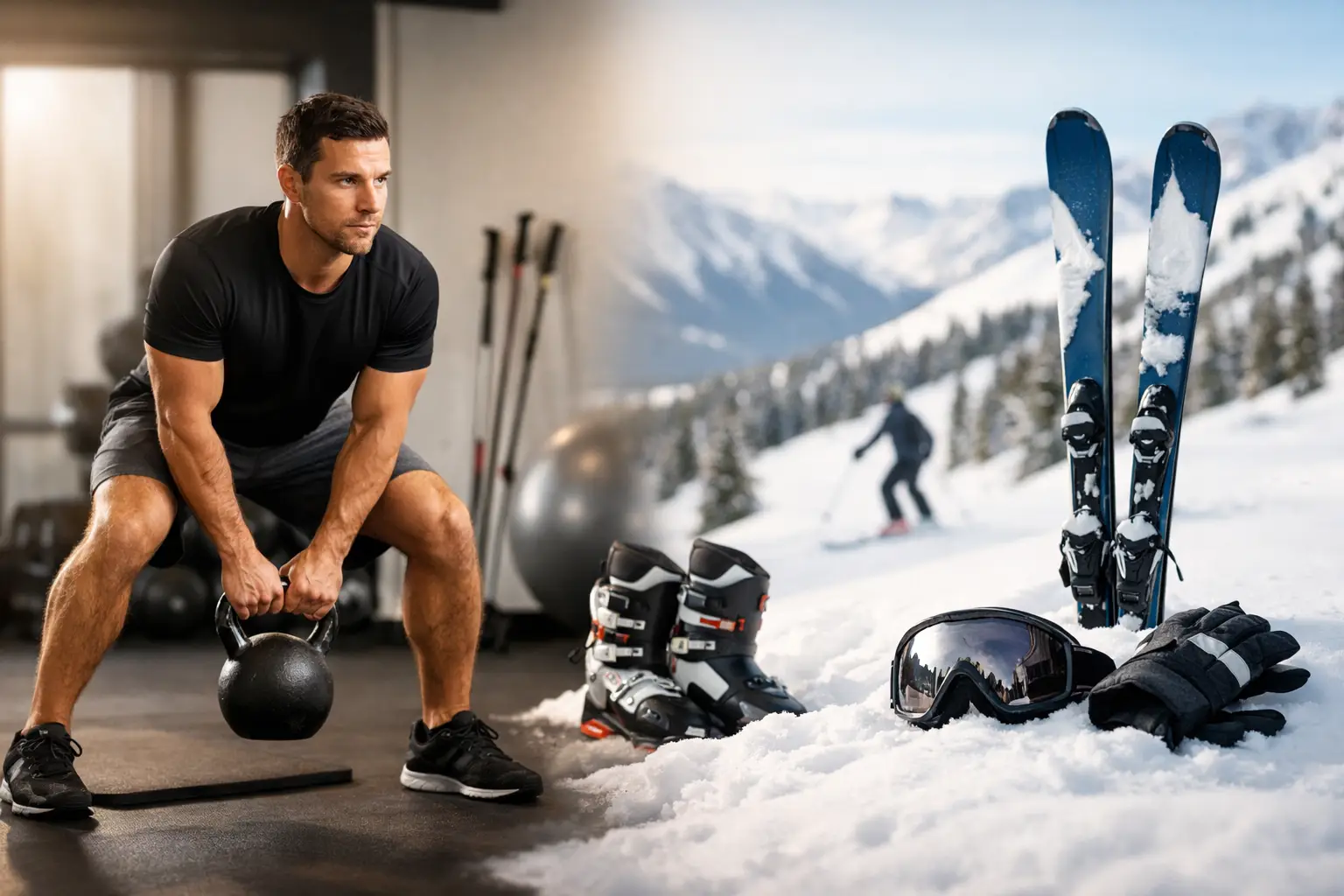
You feel it on the first red run of the holiday. The legs start to burn earlier than they should, your turns get a little scrappy, and suddenly that long lunch stop looks less optional than planned. Knowing how to train for skiing before you head to the mountains can make the difference between merely getting through the week and skiing well from day one.
The good news is that ski fitness does not need to look like elite race training. For most recreational skiers, the aim is straightforward: build enough leg strength, balance, stamina and mobility to stay in control, absorb the demands of uneven terrain, and recover properly so you can do it again the next morning. If you ski once or twice a season from the UK, a focused six to eight weeks of preparation is often enough to notice a genuine difference.
How to train for skiing: what actually matters
Skiing asks a lot of the body at once. You need strength to hold your position and pressure the ski, endurance to repeat that effort run after run, and balance to react when the snow, slope angle or visibility changes. Add in cold weather, altitude, carrying kit, and the stop-start pattern of lift-access skiing, and it becomes obvious why general gym fitness does not always transfer neatly.
The priority is not bodybuilding-style muscle gain. It is movement quality and resilience. Strong quads help, but so do glutes that fire properly, a stable core, ankles and hips that move well, and enough aerobic fitness that you are not gasping by mid-morning. If you only train one quality, endurance usually lets people down less dramatically than strength, but the best results come from combining both.
There is also a trade-off. Training hard in the final week before travelling can leave you sore and flat for the first days on snow. A smart build-up is better than a last-minute fitness panic.
Start with the movements skiing uses most
If you are wondering how to train for skiing without overcomplicating it, begin with the patterns you will actually use on the hill. Skiing is essentially repeated squatting, bracing, rotating and stabilising under load. That means your training should revolve around lower-body strength, single-leg control and core stability.
Squats are the obvious starting point because they build tolerance in the quads, glutes and hips. They do not need to be heavy barbell squats unless you already train that way. Goblet squats, bodyweight squats and split squats are all useful, especially for skiers who want practical gains without chasing gym numbers. The key is control through the full range rather than bouncing through repetitions.
Lunges and step-ups matter just as much. Skiing is rarely perfectly symmetrical, particularly on steeper pistes, chopped-up snow or tight turns. Single-leg work highlights imbalances quickly and helps build the kind of stability that keeps you composed when one ski gets knocked off line.
Hamstrings are often overlooked by recreational skiers who focus entirely on the front of the thigh. That is a mistake. Romanian deadlifts, bridges and hamstring curls support knee control and help balance all that quad-dominant work. A stronger posterior chain also tends to improve posture on skis, especially later in the day when fatigue sets in.
Balance and coordination are not optional extras
You can have strong legs and still ski inefficiently if your balance is poor. Skiing is a dynamic sport. You are constantly adjusting to edge angle, snow texture, speed and terrain, often while carrying momentum downhill. Training balance improves more than neatness – it can also reduce the risk of the awkward, low-speed falls that happen when people get tired.
Single-leg stands are a simple place to start, but progress them quickly. Reaching in different directions while standing on one leg, stepping laterally, or controlling a slow single-leg squat will do more for skiing than just wobbling on a cushion for two minutes. Unstable surfaces can have a place, but they are often overused. Better to train balance in a way that still resembles athletic movement.
Rotational control matters too. Your upper and lower body need to work together without flinging you out of position. Exercises such as dead bugs, Pallof presses and side planks teach that kind of control without pretending the gym is a ski slope.
Cardio for skiing should be practical
One of the most common misconceptions is that skiing fitness means endless running. Running can help, especially if you already enjoy it, but it is not the only route and not always the best one for everyone. What matters is that you can sustain repeated efforts and recover between them.
Cycling, rowing, brisk uphill walking, stair climbing and circuit training all work well. For many skiers, a mix of steady aerobic sessions and shorter interval work is ideal. A longer, moderate session builds your base fitness. Intervals then mimic the harder efforts of skiing a demanding run, pausing on the lift, then going again.
A practical weekly approach could include one or two 30 to 45 minute steady sessions and one interval session with short hard efforts followed by recovery. If you are already active, that may be enough. If you are starting from scratch, consistency matters more than intensity. There is no glory in arriving in resort carrying an overuse niggle from an ambitious training block.
Mobility helps you ski better, not just feel virtuous
Mobility work is easy to skip because it feels less dramatic than strength training. It is still worth doing. Restricted ankles, tight hips and a stiff thoracic spine can all affect your stance and ability to absorb terrain. If you struggle to get into a comfortable athletic position off snow, you will not suddenly find it in ski boots.
You do not need an hour-long stretching routine. A short, regular sequence is usually enough. Focus on ankle flexion, hip mobility, hamstrings and gentle spinal rotation. Bodyweight squats with a pause at the bottom, hip openers and calf stretches are all useful. The aim is to move more freely and maintain a better position, not to become a yoga instructor before your chalet week.
A realistic weekly plan for UK skiers
Most people do not have time to train every day, and they do not need to. Three to four focused sessions a week is enough for meaningful progress before a trip. Two sessions can centre on strength and control, one on cardio, and one can combine lighter conditioning with mobility. If you also use an indoor slope, dry slope or ski club session, count that as sport-specific work rather than piling everything on top.
A simple week might look like this. Early in the week, do a lower-body strength session with squats, split squats, bridges and core work. Later, add an aerobic session such as cycling or a hill walk. At the weekend, complete a second strength session built around step-ups, Romanian deadlifts, lateral movement and balance drills. Then finish the week with either intervals or a technical ski session if you have access to one.
If your holiday is getting close, taper slightly in the final few days. Keep moving, but reduce volume so you arrive fresh.
Training changes with ability level and age
Beginners often need more general conditioning than advanced technique work. If you are new to skiing, your biggest gains may come from leg endurance, basic balance and mobility, simply because the sport feels less physically overwhelming. You do not need fancy drills. You need enough fitness to practise properly instead of stopping because your legs are cooked after two hours.
Intermediate skiers usually benefit from a broader mix. This is the group most likely to spend full days on varied pistes and start pushing into bumps, crud or more demanding terrain. Here, strength and single-leg control become more important because the skiing itself gets more dynamic.
More experienced skiers may need to be honest about durability. Good technique can mask fitness gaps for a while, but long days, heavier snow and off-piste sections still expose them. Older skiers in particular should not shy away from strength work. Done sensibly, it supports joint health, stability and confidence. The focus may shift from intensity to consistency, but the principle stays the same.
What not to do before a ski holiday
The classic mistakes are familiar. People train only quads, ignore recovery, or start doing hundreds of squat jumps because skiing feels explosive. Plyometrics can be useful, but only if you already have a decent strength base and no injury concerns. For many holiday skiers, controlled strength work and sensible conditioning offer more return with less risk.
Another trap is treating ski prep as separate from sleep, hydration and general health. If you are run down, training quality drops. If you arrive in resort dehydrated and sleep-deprived after travelling, even good prep will not feel as good as it should.
And do not forget the obvious point: skiing itself is technical. Fitness helps you use your skills for longer, but it does not replace lessons. A couple of hours with a good instructor can improve efficiency enough to save your legs as much as any gym session.
If you want your next trip to feel stronger from the first lift to the final run, start early, keep it simple and train with skiing in mind. The mountain rewards preparation, and your legs usually tell the truth by day two.