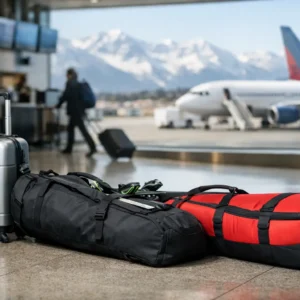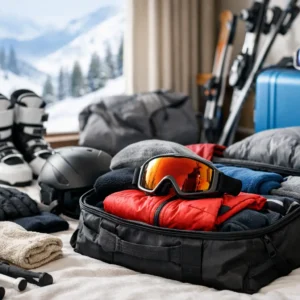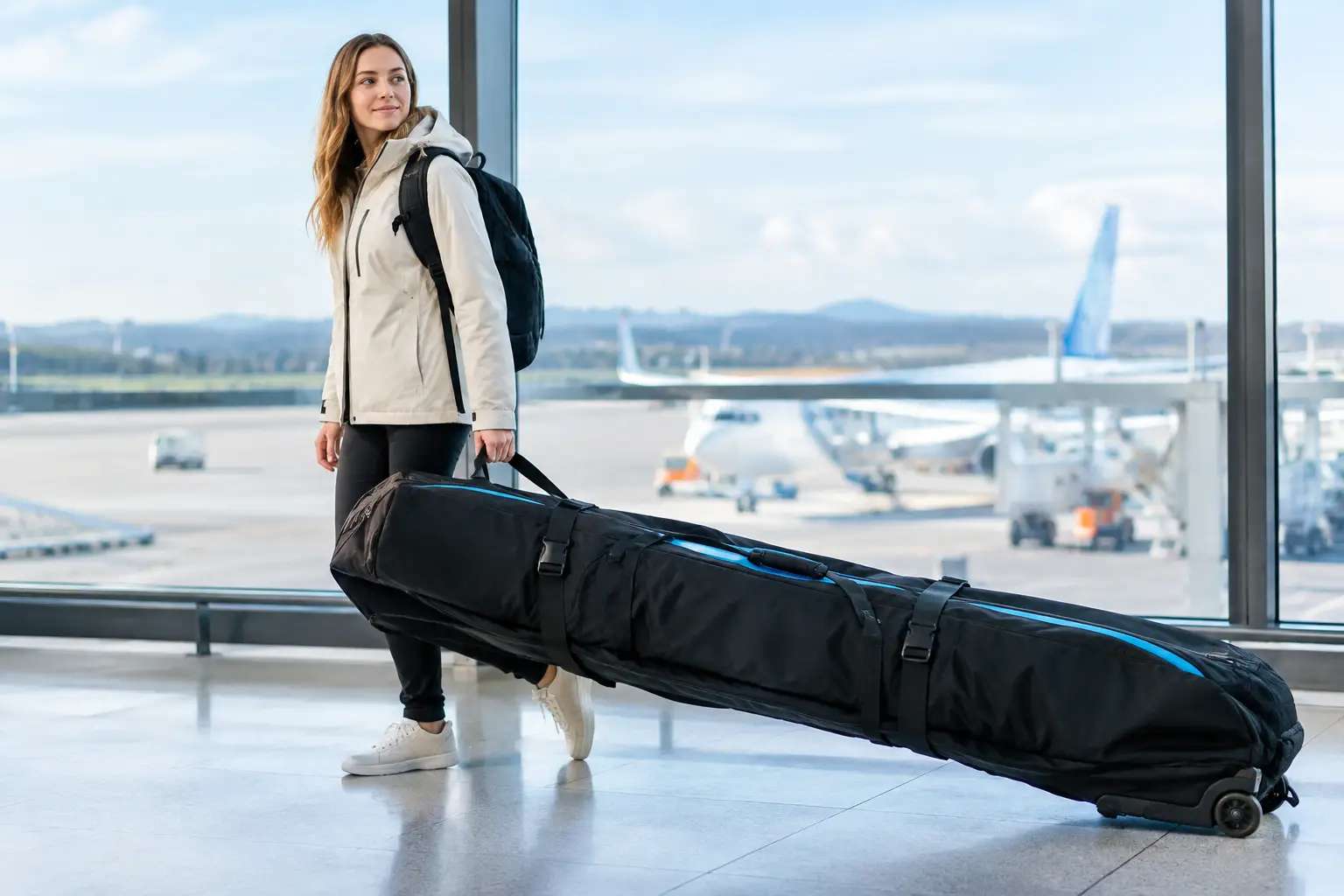
A ski holiday can unravel before you reach the mountains if your skis emerge on the oversize-baggage belt with a cracked binding, gouged edge or a strap hanging loose. The best ski bags for flying do more than make carrying kit easier: they protect an expensive, carefully chosen set-up through airport conveyor systems, coach transfers and hotel ski rooms.
For most UK travellers, a wheeled, padded ski bag is the sensible starting point. Yet there is no single perfect choice. The right bag depends on whether you are flying once a season or several times, travelling with one pair of skis or carrying family kit, and how much your airline charges for sporting equipment.
What separates a flight-ready ski bag from a basic sleeve?
A simple ski sleeve has a place. It keeps bases and edges covered in the car, on the train, or in a ski locker, and it is lighter to lift onto a scale at check-in. But thin fabric offers little defence against the moment a loaded baggage trolley catches it, or when a bag is dropped onto a hard floor. For air travel, padding around the binding area and reinforced ends matter far more than a smart-looking print.
Wheels are the other major dividing line. A long bag with skis, poles, outerwear and perhaps boots can become awkward very quickly. Good roller bags let you pull the load behind you rather than carry its full weight through a terminal. Look for substantial wheels that are recessed or protected by the bag’s base, rather than small exposed wheels likely to take a knock.
Length is equally important. Check the bag’s usable internal length against your longest skis, not just the label on the product. A 175cm ski often needs more room once the upturned tail and binding placement are considered. Adjustable bags are particularly useful for households with skis of different lengths, and tend to be less unwieldy when packed with shorter all-mountain skis.
The best ski bags for flying at different budgets
Db Snow Roller: best for regular flyers
The Db Snow Roller remains a strong choice for skiers who take several flights each winter. Its standout feature is its ability to roll down when empty, making it easier to store at home than a permanently rigid case. It is also designed to adjust around the length of the load, reducing excess fabric and the tendency for skis to slide around in transit.
This is a premium option, but it earns that price for travellers who value its practical shape, wheels and packability. It is not a hard case, so careful packing still matters. Wrap ski tips and tails, use clothing as padding around bindings, and do not assume the bag alone will defeat every baggage-handler impact.
Dakine Fall Line Ski Roller: best all-round workhorse
The Dakine Fall Line Ski Roller has long been a familiar sight in airport queues for good reason. It is a conventional padded wheeled bag with a straightforward layout, enough room for a ski set-up and the sort of tough construction that suits frequent winter travel. It is often available in several lengths, which is helpful for taller skiers and those using freeride skis.
Its appeal is simplicity. You are not paying for clever folding architecture or a highly structured interior, but you get a practical roller that does the key jobs well. Depending on the version and how it is packed, it can be tempting to fill every spare corner with clothing. Keep an eye on the scales: a well-loaded ski bag can exceed an airline’s standard baggage limit surprisingly easily.
Thule RoundTrip Ski Roller: best for organised packing
Thule’s RoundTrip Ski Roller is aimed at travellers who prefer a more structured packing system. Internal dividers and retention straps help keep skis apart and prevent poles, layers and accessories from migrating into the wrong place. That organisation can be genuinely useful when you are unpacking in a chalet corridor after an evening transfer.
It is a polished, premium bag and a particularly good fit for a skier travelling with one carefully maintained pair of skis. The trade-off is that additional organisation can mean additional material and weight. If your priority is getting as much equipment as possible into a tight weight allowance, a simpler bag may be more efficient.
EVOC Ski Roller: best for heavy-duty travel
EVOC’s ski luggage has a deserved following among riders who treat their travel kit hard. The Ski Roller is built around durability, generous padding and useful internal organisation, with a stable wheelbase that makes a difference when the bag is fully loaded. It is a reassuring option for multi-leg journeys, rail-and-air combinations, or seasons involving more than one resort.
It is not the lightest route to the airport. That is the central compromise with more protective bags: the bag itself uses part of the weight allowance before skis, bindings and clothing go anywhere near it. For travellers who already pay for a higher sporting-equipment allowance, that may be a price worth paying.
Sportube Series 2 or 3: best protection, but not technically a bag
If safeguarding skis is the absolute priority, a hard-sided Sportube deserves consideration. It is not a ski bag in the traditional sense, but its rigid shell gives better impact protection than even a heavily padded roller. This makes particular sense for expensive race skis, touring skis with fragile lightweight components, or travellers who have had equipment damaged before.
The drawbacks are obvious at the airport and at home. Hard cases are bulkier, more conspicuous and less forgiving in a small hire car or flat hallway. They can also attract extra attention from airline staff assessing oversize items. For many recreational skiers, a quality padded roller is the more balanced choice.
Pack for protection, not just capacity
Even the finest bag needs sensible packing. First, use ski straps to secure each pair and stop the brakes catching on fabric or another ski. Place a layer of clothing around the binding zone, where protruding components are most vulnerable. A jacket, salopettes or a fleece work well, but avoid packing loose hard items such as goggles, tools or a helmet next to the skis.
Poles should sit alongside the skis with their tips protected. Many skiers use pole-tip protectors, but a folded sock or thick layer also prevents punctures. Put boots in a dedicated boot bag where possible. They are heavy, awkwardly shaped and can push a ski bag over its allowance while adding little useful protection to the skis.
Before leaving home, weigh the bag properly. Airlines apply their own rules to sporting equipment, and those rules may differ between outbound and return flights, particularly on a trip involving a regional carrier or a connection. Confirm whether skis count within your checked-bag allowance, require a separate sports booking, or have a length restriction. Do it for every flight number, not simply the first airline on the itinerary.
Choosing the right size and style
For a solo skier with one pair of piste skis, a slim wheeled bag is usually enough. It is easier to manoeuvre, quicker to pack and less likely to become needlessly heavy. A wider double ski roller makes sense for two pairs of skis, a skier and snowboarder travelling together, or anyone bringing separate piste and powder set-ups.
Families should think beyond capacity. One enormous bag can be difficult to lift, impossible to fit on a small airport shuttle and over the airline’s single-item weight limit. Two manageable bags may be a better arrangement, even if it means paying for another checked item. The same principle applies to ski clubs travelling in a group: distribute weight before arriving at the desk, not while a queue forms behind you.
Do not buy solely on the basis of a claimed ski length, either. Consider handle placement, zip quality, compression straps and whether the bag will stand upright while you check passports or find a luggage trolley. These are small details until you are navigating Gatwick at 5am with gloves, boot bags and a flight to catch.
A good ski bag should quietly remove stress from the travel day. Pack it once at home, practise rolling it fully loaded, and leave enough room for the return journey. After a week of mountain weather, damp layers and a few souvenirs, that little margin can be the difference between an easy airport run and a frantic repacking session on the hotel floor.