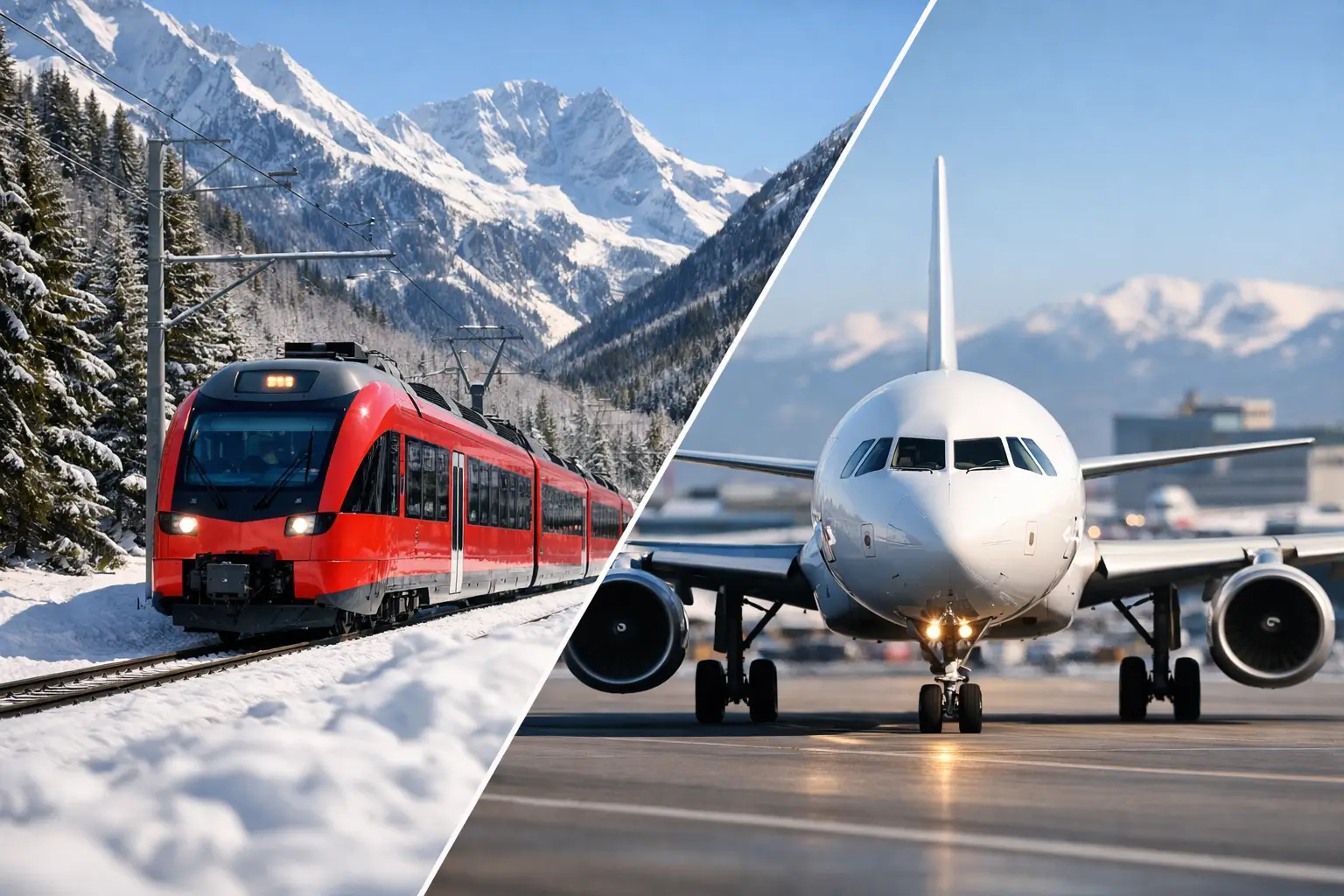
The first chair of a week in the Alps is rarely decided by your skiing ability. It is often decided much earlier, when you are weighing an airport transfer at dawn against dragging a ski bag through a station. The ski train versus flight question has no universal winner, but it can make a major difference to the cost, comfort and rhythm of a mountain holiday.
For UK skiers and snowboarders, flying remains the quickest way to reach a wide choice of resorts, particularly in Austria, Italy and the French Alps. Rail, however, has become a more compelling option for those heading to well-connected French and Swiss destinations, especially when the journey itself is part of the holiday rather than an obstacle to endure.
Ski train versus flight: start with the real door-to-door time
A flight timetable can look irresistible. A 90-minute hop to Geneva or Chambery seems decisively faster than a full day on trains. Yet airport travel has a habit of expanding around the flight itself: getting to the airport, arriving two hours ahead, bag drop, security, waiting at the gate, baggage reclaim and then the coach or private transfer to resort.
For a typical Saturday changeover, a morning flight from London to Geneva can easily become seven or eight hours from front door to chalet in Morzine, Verbier or Tignes. Add weather disruption, congestion around the airport or a delayed transfer, and the final stretch can feel particularly long after a 4am alarm.
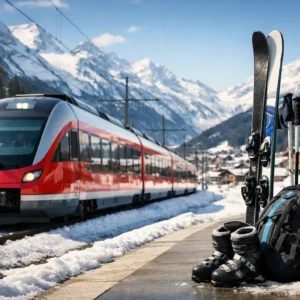
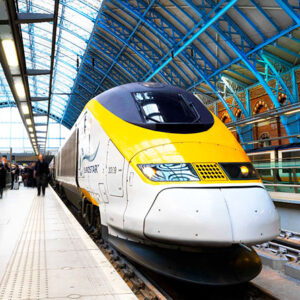
Rail usually takes longer on paper, but the time is more usable. From London, travellers can reach Paris or Lille by Eurostar and continue towards Alpine hubs such as Bourg-Saint-Maurice, Moûtiers, Aime-la-Plagne, Geneva or Zurich. Depending on the route and connections, expect roughly eight to 12 hours to many resorts. That sounds substantial, but you can read, work, eat properly, move around and arrive without the familiar airport squeeze.
The key question is not simply, ‘Which is faster?’ It is, ‘When do I step into my accommodation, and how wrecked will I feel when I get there?’ For a week in a resort close to a rail station, train travel can be remarkably civilised. For a short break or a resort requiring several changes and a lengthy final bus, flying often earns its convenience premium.
The destination matters more than the principle
Rail is at its strongest for French resorts with straightforward onward transfers. The Tarentaise, for example, has rail access at Moûtiers, Aime-la-Plagne and Bourg-Saint-Maurice, putting sizeable parts of the Three Valleys, Paradiski and Espace Killy within reach. The transfer still matters: a station at the bottom of a valley is not the same as a station in resort.
Swiss rail is often excellent once you have crossed the Channel, with integrated services reaching places such as Zermatt, Wengen and St Moritz. But journey times from the UK can be long, and the fares need careful checking. Austria and the Dolomites can work well by train for travellers willing to break up the journey or use overnight services, but flights generally remain the simpler option for a Saturday-to-Saturday holiday.
Cost: cheap fares can be misleading
The flight price on a booking screen is rarely the total price paid by a skier or snowboarder. Hold luggage, carriage of skis or a snowboard, seat selection, airport parking or rail to the airport, and a resort transfer can turn a low headline fare into a noticeably different figure.
Train fares can also be expensive, especially when booked late, during school holidays or on the most popular Saturday travel dates. A family of four may find that rail costs more than flying, even before adding station-to-resort transport. There is no point pretending otherwise.
What rail can offer is clarity. You are less likely to be stung by a separate sports-equipment charge, and luggage allowances are generally more generous. Booking early is crucial, particularly where Eurostar and peak Alpine services are involved. Flexible travellers who can travel midweek, take an overnight stop in Paris or depart from outside London may find better value and a less frantic journey.
For groups, do the arithmetic for the whole party rather than comparing one adult airfare with one rail ticket. Include every transfer, every bag and, if you are driving to the airport, the parking. Also consider the value of a first and last day: an early flight may give you an extra afternoon on snow, while a late arrival by train could effectively remove it.
Luggage, ski bags and the kit question
This is where many committed riders begin to favour rail. Taking your own skis or snowboard removes rental uncertainty and means arriving with boots that fit, bindings you trust and a setup tuned to your preferences. It is also useful for families, racers and anyone travelling with avalanche equipment or a large amount of winter clothing.
On a train, the challenge is physical rather than bureaucratic. A ski bag, boot bag and suitcase are manageable until a tight connection, a staircase or a crowded platform enters the picture. Pack with the changes in mind. A wheeled bag and a separate backpack are usually easier than attempting to carry everything at once, and a compact snowboard bag is far less troublesome than an oversized rolling coffin.
Flights can be easier if you are renting equipment in resort. Travel light with boots in your hold luggage or, if practical, wear them in a cabin bag and collect skis or a board on arrival. For beginners and occasional holidaymakers, renting can make the flight route much less stressful. For experienced skiers who dislike unfamiliar boots or snowboarders with a carefully dialled-in stance, paying to take personal equipment may still be worthwhile.
Comfort and reliability on a winter weekend
There is a particular pleasure in leaving St Pancras with coffee in hand and watching the journey change from grey city to snowy valley. Rail gives a holiday a gentler beginning, and for solo travellers it can feel notably less lonely than an airport and coach transfer routine.
It is not immune to disruption. French rail strikes, missed connections and heavy snow can cause problems, and one late service can complicate a multi-leg itinerary. Build in contingency where possible. A connection of 15 minutes may look efficient but is a poor choice when you are managing winter luggage and travelling on a busy weekend.
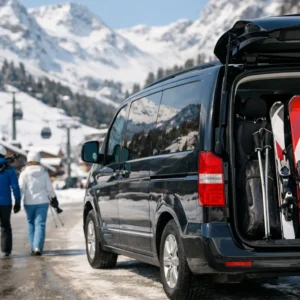
Flying has its own vulnerabilities: wind, fog, staff shortages, runway queues and the capacity limits of small Alpine airports. Once airborne, it is usually direct and efficient. The difficulty comes when many arrivals land together and the transfer roads into resort are under pressure. Anyone who has spent three hours inching up the Tarentaise on a Saturday understands why a station transfer can have real appeal.
Carbon is part of the choice, not a badge of honour
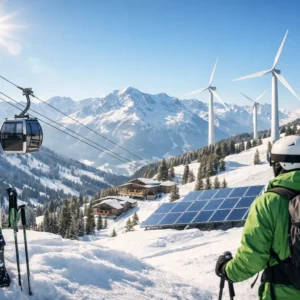
For travellers trying to reduce the impact of a ski holiday, rail is normally the stronger option. Flying is carbon-intensive, while rail travel is generally lower-impact, particularly on electrified routes. That matters in an industry reliant on cold winters, dependable snow and healthy mountain environments.
Still, the decision should be practical rather than performative. A family travelling from Cornwall to a remote Austrian resort may face a needlessly complicated rail itinerary. Someone living near London and heading to the Tarentaise has a much clearer case for taking the train. Taking fewer but longer holidays, staying in one resort and choosing public transport locally can be meaningful decisions whichever route you take.
Who should choose what?
Choose the train if you are heading to a rail-friendly French or Swiss resort, can book early, value taking your own kit, and are happy to trade a few hours for a calmer journey. It is particularly good for week-long trips, couples, solo travellers and anyone who sees the travel day as part of the mountain experience.
Choose the flight if you are taking a short break, travelling to Austria, Italy or a less accessible resort, have a tight budget based on genuinely inclusive fares, or need the fastest possible door-to-door journey. It also makes sound sense for beginners planning to rent equipment in resort.
For many Skier & Snowboarder readers, the most useful approach is to stop treating rail and air as rival identities. Pick the route that suits the resort, the group and the holiday you actually want. A relaxed train journey can set up an excellent week on snow, but so can a well-timed flight that gets you onto the first lift while everyone else is still unpacking.