The transfer is rarely the part of a ski holiday anyone looks forward to, yet it can set the tone for the whole week. A well-chosen option gets you from airport or station to the lifts with enough energy for a first-afternoon lap; a poor one can mean a long wait, an overfilled minibus and a weary trudge through snow with a board bag. This guide to ski resort transfers is designed to help UK skiers and snowboarders make the right call before departure day.
The best choice is not automatically the cheapest or quickest on paper. It depends on your group size, arrival time, luggage, budget, resort access and appetite for driving on winter roads. A couple flying into Geneva for a car-free break in Morzine has different needs from a family with two children, or a group heading deep into the Tarentaise with skis, boards and a week’s worth of kit.
A guide to ski resort transfers: match the journey to the trip
Start with the airport or rail gateway, rather than the resort brochure. Some resorts have genuinely straightforward connections: Geneva to much of the Portes du Soleil, Innsbruck to Tirol’s major valleys, and Zurich to several Swiss destinations can be relatively painless. Others demand more commitment, particularly high-altitude purpose-built resorts and smaller villages at the end of a valley.
Transfer time is only one part of the equation. A quoted journey of 90 minutes may be a private car taking the direct route, while a shared shuttle can stretch considerably if it is waiting for late flights or dropping passengers at several hotels. On a Saturday changeover, the same road can be very different at 10am and 4pm.
When comparing options, look closely at the arrival process. Does the operator meet you in the terminal or at a car park? Is there a fixed departure time? Are flight delays covered? Is your accommodation on the main road, or will the vehicle stop at a central point? These details matter more after a 5am start from the UK than they do when you are booking from the sofa.
Shared transfers: good value, with less control
Shared shuttles remain a sensible option for solo travellers, couples and smaller groups. They are often cheaper than a private vehicle, remove the stress of winter driving and can work particularly well on popular routes where there are regular departures.
The compromise is flexibility. You may wait for other arrivals, make additional stops, or find that your return collection is earlier than you would choose. That last point is worth checking carefully: an early airport run can eat into the final morning’s skiing, especially if your resort is two or more hours from the airport.
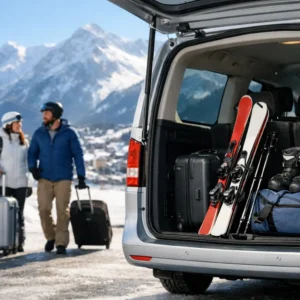
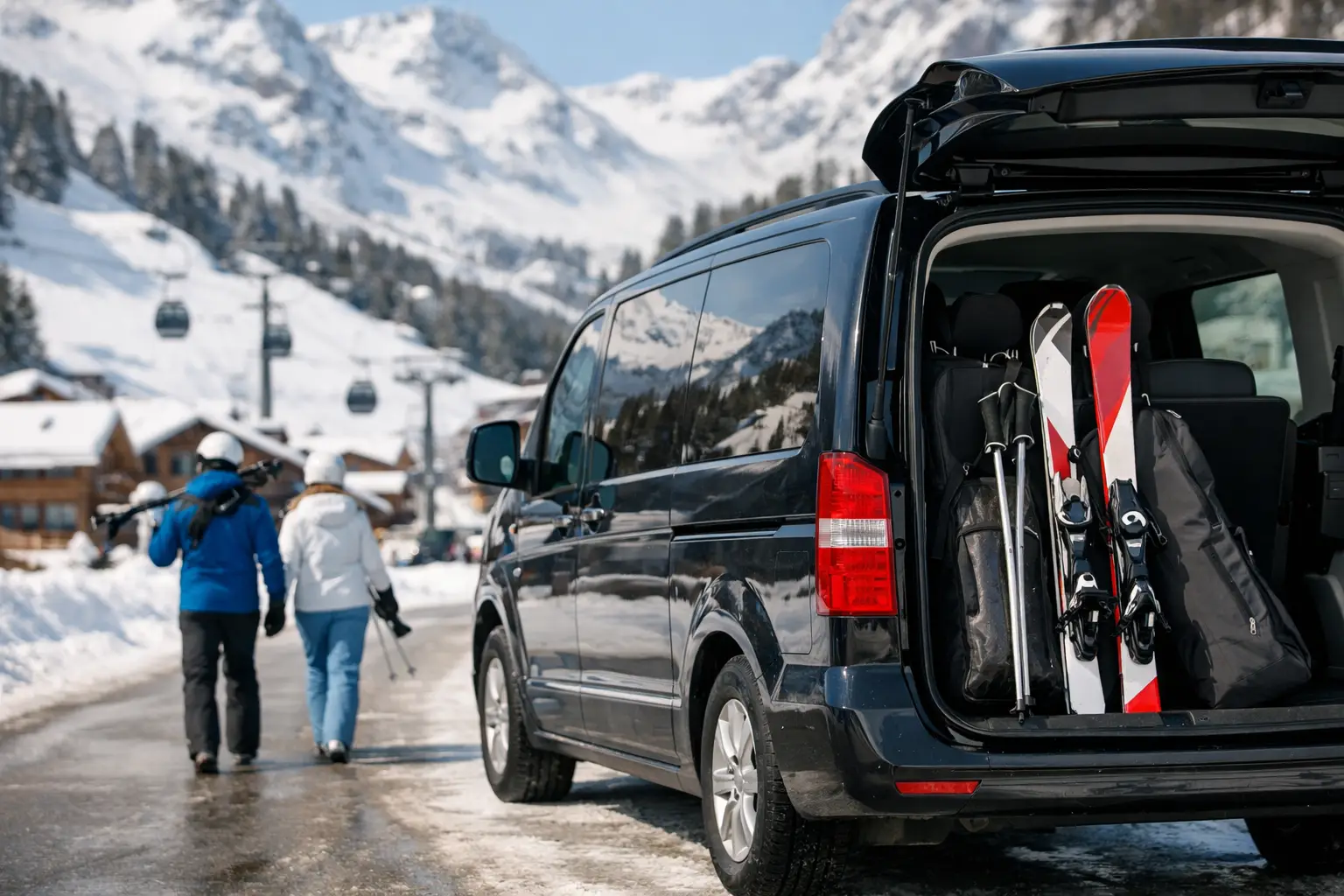
For snowboarders and skiers carrying their own equipment, confirm the baggage policy before booking. Most specialist operators expect ski and board bags, but capacity is not unlimited, and budget fares can be less generous than they first appear. If you are travelling with a pushchair, several large suitcases or an avalanche backpack, say so in advance rather than hoping it will fit.
Shared services are at their best when the route is busy, your flight lands at a civilised hour and saving money matters more than leaving exactly when you want. They are less attractive for late arrivals, young children or resorts with a lengthy final climb.
Private cars and taxis: pay for certainty
A private transfer costs more, but the value becomes clearer once there are three or four people in the party. Split between a family or group of friends, the difference from individual shared-shuttle fares can be smaller than expected. You also gain direct travel, room for luggage and a driver working to your flight time rather than a pooled timetable.
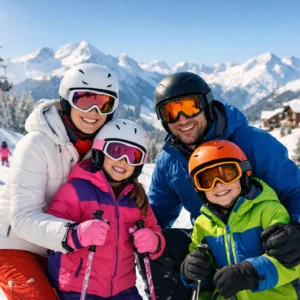
This is often the strongest option for a short break. On a three-night trip, losing half a day at each end to transfer logistics is a poor return on the cost of flights and lift passes. Private transfers are also useful when travelling with children, older relatives, race kit, or enough luggage to make a standard minibus feel optimistic.
That said, private does not always mean door-to-door. In heavy snow, during pedestrianised village hours, or at properties up narrow lanes, vehicles may stop a short walk away. Ask whether snow chains are carried and whether the fare includes road tolls, parking and any late-night supplement. A headline price that excludes these extras is not the price you will actually pay.
Train transfers: the relaxed choice, when timings work
Rail can be the most enjoyable way to reach a resort, especially in Switzerland and Austria, where mountain rail networks are built into the holiday experience. It offers more space to move, no concern about icy roads and a chance to arrive in a resort without hiring a vehicle that will sit unused all week.
For British travellers, the limiting factor is usually the flight-to-train connection. A missed service after a delayed flight can quickly remove the calm from the equation, particularly where the final mountain train runs only hourly or less. Build in breathing room and check the final service of the day before committing to an evening flight.
Train travel is a particularly good fit for car-free resorts, city-and-mountain combinations, and travellers who pack efficiently. It can be harder work with multiple children and bulky luggage, although plenty of experienced skiers prefer a wheelable ski bag and a rucksack to the uncertainty of road transfers. In Switzerland, the last section of the journey can be as memorable as the skiing itself.
Hiring a car: freedom with responsibilities
A hire car gives you the greatest independence. It can make sense for a multi-resort itinerary, a self-catered stay away from the lifts, or a group splitting costs. It also creates useful options for supermarket runs, visiting neighbouring valleys and escaping a weather system that has settled over one side of the mountains.
But self-drive is not a default upgrade. Winter tyres are essential in alpine conditions, and some countries have specific legal requirements around tyres, chains or other equipment. Check what is included with the hire firm rather than assuming that a vehicle collected at an airport is fully prepared for a snowy pass. Automatic cars can be harder to find and more expensive, too.
Think honestly about the final approach to your accommodation. A clear motorway journey from Geneva to the valley floor is very different from a steep, unploughed lane after dark. Parking may carry a significant weekly charge in major resorts, and a car can become a burden in compact, pedestrian-friendly villages. If it will not move from Sunday to Friday, a transfer is usually the more sensible spend.
Timing, weather and the Saturday problem
Saturday remains the pressure point across many European ski areas. Airports, hire-car desks and valley roads are at their busiest, while snowfall can turn routine journeys into slow ones. A transfer company that looks expensive on a quiet midweek search may be offering genuine reassurance on a peak Saturday.
Avoid tight connections where possible. If your flight lands at 3pm and the advertised transfer takes two hours, do not assume you will be checking in at 5pm. Factor in baggage reclaim, delays, vehicle collection, traffic and the final walk to your accommodation. For an important first-night restaurant booking or equipment fitting, leave room for reality.
The return journey deserves equal attention. Confirm the collection point and time a few days before departure, keep the provider’s contact details accessible, and allow for snow clearing or road restrictions. If your flight is early, consider staying near the airport on the final night rather than sacrificing the last day entirely to an alarm clock.
Book for your actual luggage and ability to cope with it
Transfers are a practical part of the holiday, but they are also a physical one. Carrying a ski bag, board bag, boot bag and suitcase through an unfamiliar station or across an icy resort square is manageable for some travellers and miserable for others. There is no badge of honour in choosing the cheapest route if it means beginning the week exhausted.
First-timers often benefit from a direct transfer, even if it costs more, because it removes one unfamiliar element from an already busy holiday. Experienced riders may happily trade convenience for rail travel, a rental car or a lower shared-shuttle fare. The right answer is the one that leaves you ready to enjoy the mountain, not simply the one with the lowest booking confirmation total.
Before you book, picture the journey in full: arrivals hall, baggage belt, meeting point, road or platform, resort stop and the final few metres to your door. If that picture feels straightforward, you have probably chosen well. If it involves several hopeful assumptions, spend a little more time – and, where it earns you a better first day on snow, perhaps a little more money – getting the transfer right.