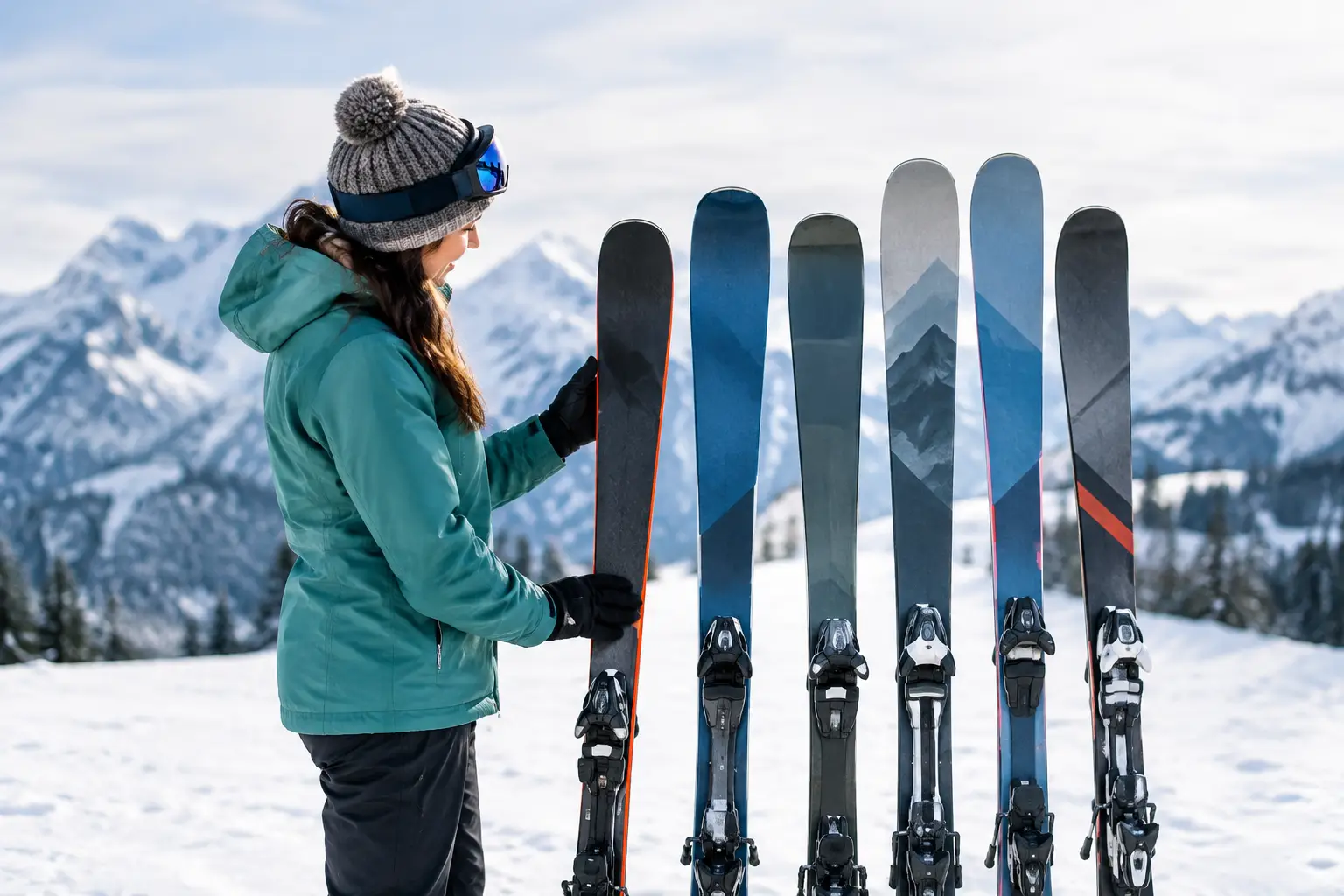
You can be standing in a ski shop, staring at two pairs that differ by only 7cm, and still be choosing between a confidence-boosting holiday and a week spent fighting your skis. Which ski length fits is not answered by height alone. Your weight, technique, preferred terrain and the shape of the ski all matter – and modern ski design has made the old chin-to-forehead rule less reliable than it once was.
For most recreational skiers, the right length is the one that feels composed when the piste becomes chopped up, yet easy enough to steer when the legs are tired at 3pm. It should support the skiing you do now while leaving enough room to improve.
Which ski length fits your height and ability?
Height is the sensible place to start, but treat it as a reference point rather than a verdict. On a traditionally shaped piste ski, beginners will usually be comfortable with a length around chin to nose height. Intermediates tend to move towards nose to forehead height, while confident, faster skiers may choose a ski at forehead height or a little taller.
As a broad example, a skier around 170cm tall might begin their search in the 155-165cm range if they are new to skiing, 165-172cm as a developing intermediate, and 170-177cm for confident piste skiing. Those numbers are not interchangeable across every model. A 172cm all-mountain ski with pronounced rocker can ski noticeably shorter than a 172cm cambered frontside ski.
Ability matters because a shorter ski has less edge in contact with the snow and a shorter turning platform. That generally makes it easier to pivot, control speed and link turns at modest pace. A longer ski offers greater stability, grip and support in variable snow, but demands more deliberate input. Neither is automatically better. A newer skier on a ski that is too long can feel as though the tips are constantly running away; a powerful skier on one that is too short may find it nervous and vague when speed builds.
Weight and strength change the answer
Two skiers of the same height can need different lengths. A heavier or particularly strong skier flexes a ski more easily, so may benefit from sizing towards the longer option. A lighter skier, or someone returning after a lengthy break, may prefer the shorter option for easier bending and initiation.
This is especially relevant with stiff, performance-oriented skis. If you are 175cm tall but light, cautious and working on parallel turns, a demanding 175cm piste ski is unlikely to be the shortcut to better skiing. Conversely, a strong 175cm skier who enjoys charging through afternoon crud may quickly outgrow a soft 165cm model, even if a simple height chart suggests it.
Start with the ski category, not the number
The number printed on the tail is only useful when you know what sort of ski it belongs to. Construction, waist width, sidecut and rocker all affect how a ski behaves.
Piste and frontside skis
Narrow-waisted piste skis are designed to carve cleanly on groomed snow. Their effective edge is often long, particularly on models with traditional camber and limited rocker. For that reason, many recreational skiers are best served by a length close to nose or forehead height rather than automatically going long.
Short-turn, slalom-inspired skis can be enjoyable a few centimetres shorter, particularly for skiers who like quick direction changes on busy pistes. A more powerful, longer-radius piste ski rewards speed and stronger technique, so sizing up can make sense if you genuinely ski that way rather than simply liking the idea of it.
All-mountain skis
All-mountain skis are the logical choice for many British skiers travelling to the Alps: they cope with morning corduroy, soft snow beside the piste and the inevitable chopped-up run home. They also vary enormously.
A ski around 80-90mm underfoot with modest rocker may suit an intermediate around forehead height. A wider 95-105mm ski with generous tip and tail rocker has less effective edge on firm snow and often feels shorter than its stated length. In that case, a skier may be happier choosing the longer of two recommended sizes, provided their technique and confidence support it.
Do not confuse a wider ski with a more versatile one in every UK holiday situation. If your week is likely to be mostly groomed pistes in hard-packed conditions, an overly wide ski can be slower edge to edge and less reassuring on firm snow. The right length cannot compensate for the wrong category.
Freeride, powder and touring skis
In soft snow, longer skis provide float and stability. Rocker helps the tips rise rather than dive, which is why freeride skis are commonly skied longer than piste skis. Confident off-piste skiers may choose a ski at their height or beyond it, particularly with a heavily rockered profile.
There is still a trade-off. A longer, wider ski is more work in tight trees, narrow gullies and awkward refrozen snow. For a skier building experience away from the marked runs, a slightly shorter, manageable freeride ski is usually more useful than an oversized powder tool that only comes alive in ideal conditions.
Touring introduces another consideration: weight. A very long ski may give welcome downhill confidence but becomes more cumbersome on kick turns and long ascents. Choose a length that suits the terrain you tour in, not just the descent you hope to find.
Rocker, camber and effective edge explained
The most common sizing mistake is comparing lengths without comparing profiles. Camber is the upward arch underfoot that helps a ski grip and rebound through a carved turn. Rocker is the early rise in the tip or tail. It makes a ski easier to pivot and improves float in soft snow.
A fully cambered 170cm ski may feel precise and substantial along much of its length. A 170cm ski with long rockered sections at both ends has a shorter effective edge on hard snow, making it feel more manoeuvrable. That is why the same skier can sensibly own, or enjoy, very different lengths in different skis.
Sidecut plays its part too. A deep sidecut creates a tighter natural turn shape and can make a ski feel eager to turn. A straighter ski is more composed at speed but may need more space and commitment. When comparing two lengths, look at the manufacturer’s stated turn radius and profile alongside the centimetres.
How to choose between two ski lengths
If you are squarely between sizes, be honest about where and how you ski for most of the week. Choose the shorter option if you are a beginner or lower intermediate, are lighter for your height, prefer slow-to-moderate speeds, enjoy short turns, or mainly ski busy pistes. It will be easier to control and less tiring while you refine your technique.
Choose the longer option if you are heavier or stronger, ski fast with a stable parallel stance, favour open pistes and variable snow, or are buying a rockered all-mountain or freeride model. The extra length gives a more planted feel and a bigger platform when conditions deteriorate.
Age, fitness and ski days matter as well. A skier who manages one precious week each season does not need to buy the same ski as a local who skis 40 days. There is no prize for choosing the most aggressive option in the rack. A ski that feels friendly from the first run gives you more time to learn, explore and enjoy the mountain.
Use a proper ski boot fitting and demo day
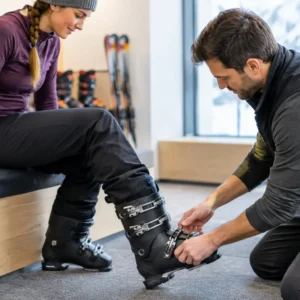
Your boots are the connection to the ski, so poor boot fit can make a correctly sized ski feel difficult. If your heel lifts, your lower leg moves inside the boot or you are constantly in the back seat, changing ski length will not solve the underlying problem. A good boot fitter and a specialist ski retailer should ask about your ability, build, preferred terrain and the resorts you visit, rather than selecting from height alone.
Whenever possible, demo skis in more than one length. Try them on the kind of run you actually enjoy, not only on a freshly groomed, empty blue piste. Make a few short turns, let the ski run, take it through churned-up snow and notice whether you are driving it comfortably or merely coping with it. This is where a sensible recommendation becomes a personal answer.
Before buying, tell the retailer whether you want a dedicated piste ski, an all-mountain one-ski-quiver, or something for genuine off-piste days. Ask how much rocker the model has and which length they would put you on if conditions are firm. Those conversations are far more useful than measuring a ski against your face in the shop.
The best ski length should disappear beneath you: secure enough that you trust it when the slope steepens, nimble enough that you still want one more run. Start with the guidelines, then let your own skiing – and the snow you intend to ski – make the final call.