A pair of cold feet can turn a bluebird day into a countdown to the next mountain restaurant. For skiers who have tried thicker socks, warmer boots, boot heaters and the usual toe-wriggling routine with little success, this heated ski socks review asks the useful question: are battery-powered socks a genuine solution, or simply another expensive item competing for space in the boot bag?
The short answer is that good heated ski socks can make a substantial difference for the right skier. They are not a substitute for properly fitted boots, dry feet or sensible layering, and they do introduce charging, battery and fit considerations. But for people whose toes regularly go numb – particularly on cold lift rides, long piste days or while standing around with children in ski school – they can be one of the more effective comfort upgrades available.
What heated ski socks actually do
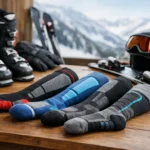
Heated socks use slim heating elements, generally positioned across the forefoot and around the toes, powered by small rechargeable batteries that sit in a pocket near the top cuff. Most offer several heat settings controlled by a button on the battery, a remote control or a mobile app.
That placement matters. A ski boot compresses the foot, restricts circulation and creates a chilly environment around the toes, especially when temperatures fall or boots are slightly too roomy. Heated socks do not make the whole foot feel like it is beside a radiator. At their best, they provide low, even background warmth at the point where many skiers need it most.
The sensation should be subtle. If a sock feels fiercely hot when tried on at home, it may become uncomfortable once the foot is enclosed in a close-fitting ski boot. The better systems deliver a gradual warmth that keeps cold at bay rather than attempting to rescue already frozen toes.
Heated ski socks review: the points that matter on snow
Warmth and heat coverage
The first test is not whether the socks heat up, but whether their warmth reaches the right area without creating hot spots. Look for heating that covers the toes and forefoot rather than a small patch beneath the ball of the foot. Heat under pressure can feel unpleasant in a performance-oriented ski boot, while warmth over the toes is usually far more useful.
Multiple settings are worthwhile. Low is often enough for a reasonably cold day and preserves battery life; a higher setting is valuable for sub-zero mornings, sedentary lift journeys and anyone with poor circulation. It is better to start low and increase heat only when needed. Running at maximum from the first chairlift is the quickest way to flatten a battery before the final run.
Expect heated socks to take the edge off the cold rather than transform a poorly insulated, ill-fitting boot. If your feet are cold because your boots are too tight across the instep, too loose at the heel or persistently damp, solve those issues first. A professional boot fit remains a much better investment than using electronics to disguise a problem.
Battery life in real ski-day terms
Battery claims require a little interpretation. A manufacturer may quote a long run time, but that figure will normally refer to the lowest setting in mild conditions. On high heat, battery life can be considerably shorter, often nearer three to five hours depending on the model, the temperature and the age of the battery.
For most recreational skiers, that can still be enough. Use a low setting during active skiing, switch up for exposed chairlifts or lunch outside, and turn the system off if your feet are already warm. Skiers planning a full day on the mountain, particularly in very cold parts of Scandinavia, North America or the high Alps, should favour a higher-capacity battery or carry a spare where permitted and practical.
Charging is the less glamorous part of ownership. Batteries need topping up after use and should not be left flat for months between holidays. If you take only one annual ski trip, set a reminder to check them before packing. There is little more irritating than discovering the night before travelling that the batteries have not held their charge.
Fit inside a ski boot
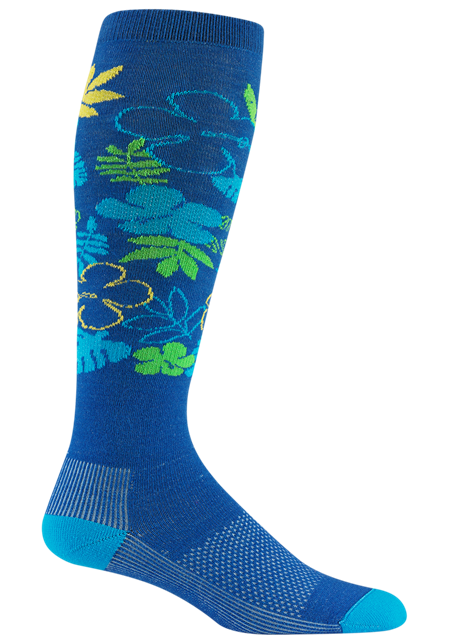
A heated sock still needs to behave like a proper ski sock. It should be close-fitting, breathable and free from bulky seams around the toes, heel and shin. Merino blends are popular because they manage moisture well and feel comfortable against the skin, while synthetic fibres can add durability and improve shape retention.
Avoid the instinct to choose a thick heated sock for extra warmth. In a fitted ski boot, bulk can reduce circulation and create pressure points, which may leave feet colder rather than warmer. A thin or medium-weight model is normally the sensible choice, especially for skiers in snug performance boots.
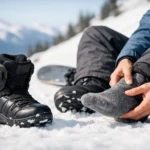
The battery pocket must sit securely above the boot cuff. On many models this is straightforward, but it is worth trying the socks with your own boots before the holiday. A tall boot cuff, a tight trouser gaiter or a low battery pocket can create an awkward pinch around the calf. Snowboarders should pay particular attention: the more flexible cuff of a snowboard boot can make battery placement more noticeable than it is in a rigid ski boot.
Controls, gloves and practicality
Simple controls win on the mountain. A button large enough to use with gloves on is often more useful than a feature-heavy app, although app control can be handy for checking battery level or adjusting left and right socks individually.
That said, mobile apps rely on a charged mobile phone, Bluetooth connection and enough patience to use them in a blizzard. For most people, reliable physical controls are the priority. Check whether the socks display the selected heat level clearly. It is surprisingly easy to leave one sock on a different setting and only notice on the chairlift.
A spare charging cable is also sensible if you are travelling as a family or sharing accommodation. Heated socks, heated gloves, mobile phone power banks and action cameras can create a surprisingly competitive queue for plug sockets.
Who will benefit most?
Heated ski socks make most sense for skiers who repeatedly suffer from cold toes despite wearing correctly sized boots and quality technical socks. They are particularly helpful for people who feel the cold more keenly, those with circulation issues who have been advised it is suitable by a clinician, instructors and guides spending long periods stationary, and parents standing at nursery slopes or waiting outside lessons.
They can also be a confidence booster for newer skiers. Learning involves more standing, stopping and riding lifts than a fluid day of carving, so feet may cool faster. A modest level of warmth can make the entire experience more enjoyable and keep attention on technique rather than discomfort.
They are less compelling for the skier whose feet are rarely cold, for warm spring conditions, or for anyone who dislikes managing batteries and charging. If the issue is only occasional, an insulated boot, a better footbed or a disposable toe warmer for the coldest day may represent better value.
Safety and care are part of the purchase
Buy from an established winter-sports brand or retailer and follow the supplied charging instructions. Inspect socks, cables and battery connectors regularly, and do not use damaged components. The electronic parts should be removed before washing where the instructions require it, and socks should be fully dry before the next outing.
People with diabetes, reduced sensation in the feet, circulation conditions or other medical concerns should seek medical advice before using heated garments. The risk is not simply overheating; reduced sensation can make it harder to notice an issue early. Heated socks should feel comfortably warm, never painfully hot.
It is also worth considering travel. Rechargeable battery packs are generally best carried in hand luggage, subject to airline rules and the battery specification. Check your carrier’s current guidance before departure rather than assuming last season’s advice still applies.
The verdict
Heated ski socks are a premium comfort purchase, not essential kit for every holidaymaker. Yet for the skier whose toes routinely spoil otherwise excellent days, they can be far more than a gimmick. Choose a slim, well-made pair with toe-focused heat, genuinely useful low settings and battery capacity that matches the way you ski.
Use them as part of a wider cold-feet plan: boots that fit, dry socks each morning, enough room to keep circulation moving and sensible heat management through the day. Get those foundations right, and a little controlled warmth at the toes can make the last lift feel as inviting as the first.
Related Posts:

Categories: Resort News & Reports
Leave a Reply
You must be logged in to post a comment.