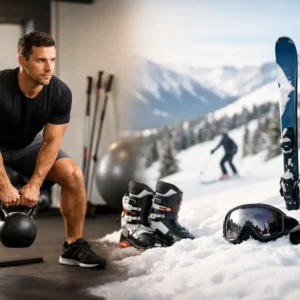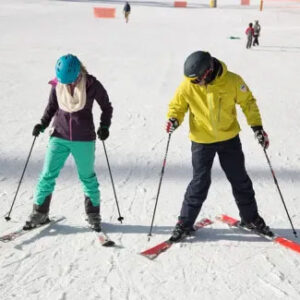
The first proper run of a ski holiday can be a rude awakening for anyone whose legs have spent the previous months behind a desk, in a car or on the sofa. Ski fitness exercises at home will not replace time on snow, but they can make a major difference to how confidently you ski on day one – and whether you still have the legs for the final lift.
The aim is not to train like a World Cup racer. For most UK skiers and snowboarders, the useful work is building stronger legs, a more stable core, better balance and enough fitness to maintain good technique when the pistes become chopped up after lunch. A small amount of consistent training, started six to eight weeks before departure, is far more valuable than one punishing session in the week before you fly.
Why ski fitness is different from general gym fitness
Skiing asks your body to absorb repeated forces while moving through a flexed position. Your quads work hard to control each turn; your glutes and hamstrings support hip position; your core keeps your upper body calm as the terrain changes. Add boots, altitude, uneven snow and a long descent, and even a competent skier can find tiredness arriving sooner than expected.
Snowboarding has similar demands, with a particular emphasis on ankle, hip and trunk control. Riders also benefit from practising getting up from the floor, as well as developing the leg endurance needed to stay composed through heel-side and toe-side turns.
Running or cycling is useful for general fitness, but it does not fully prepare you for the eccentric loading of skiing – the controlled lowering action that happens as you resist the force of each turn. That is why simple strength movements, performed slowly and with good alignment, earn their place in any pre-holiday routine.
Ski fitness exercises at home: the essential movements
You do not need a rack of weights or a complicated programme. A clear patch of floor, a sturdy chair or step, and perhaps a resistance band are enough. Start with two sessions a week, leaving at least a day between them. Once the movements feel familiar, add a third shorter session or increase the number of rounds.
Squats for strong, durable legs
A bodyweight squat is the foundation. Stand with feet roughly hip-width apart, sit your hips back and down, and keep your knees tracking in the same direction as your toes. Lower only as far as you can without your heels lifting or your lower back rounding, then stand with control.
Aim for three sets of 10 to 15 repetitions. The descent matters as much as the rise: take three seconds to lower, pause briefly, then stand. This builds the braking strength your quads use all day on the piste. If standard squats are easy, hold a loaded rucksack close to your chest. If they are uncomfortable, use a chair as a depth guide rather than forcing a deeper position.
Split squats for each leg independently
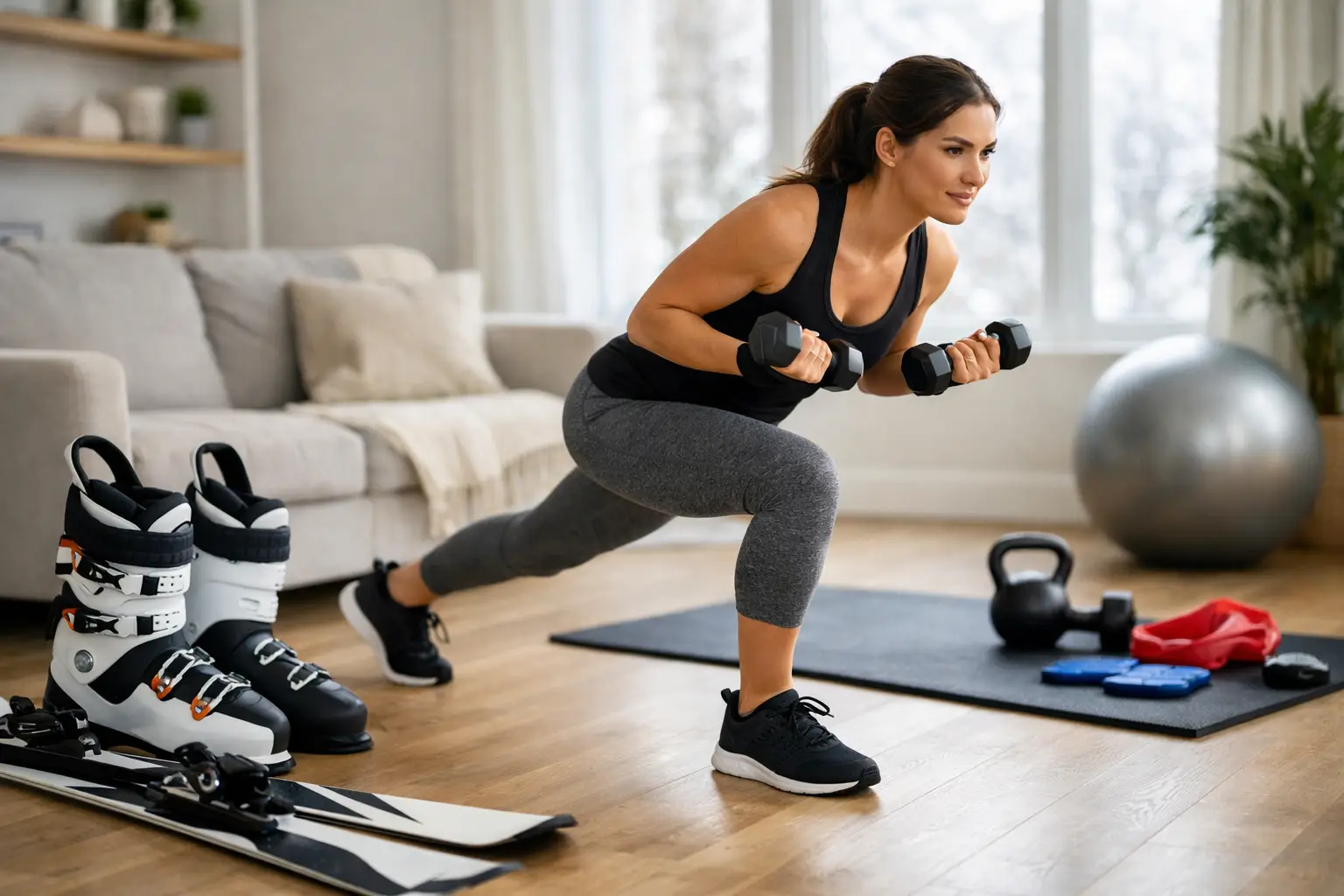
Most skiers have a stronger side, and two-legged exercises can hide the difference. In a split squat, take a long step back, keep most of your weight through the front foot and lower the back knee towards the floor. Your torso should stay tall, while the front knee follows the line of the toes.
Complete eight to 12 repetitions on each side for two or three sets. This exercise is particularly worthwhile for anyone who notices one knee tiring first on holiday. It is demanding, so reduce the range of movement or hold a wall lightly for balance if needed.
Step-ups for piste-ready control
Use the bottom stair or a stable step, not a wheeled chair or anything that can slide. Place one full foot on the step, press through that foot and stand up without pushing excessively from the trailing leg. Step down slowly.
Do 10 repetitions per side, then repeat for two or three rounds. A slow descent is the valuable part here, mirroring the controlled loading of a turn. Keep the step low at first. Higher is not necessarily better if it makes your pelvis twist or your knee collapse inwards.
Wall sits for the familiar burn
A wall sit is not glamorous, but the sensation will be recognisable to anyone halfway down a long red run. Slide down a wall until your thighs are close to parallel with the floor, with feet slightly forward of the knees. Hold for 30 to 45 seconds, rest, then repeat two or three times.
Build gradually towards 60 seconds rather than chasing discomfort immediately. A wall sit improves tolerance in the bent-knee position common in skiing, but it should sit alongside moving exercises. Holding one position alone does not prepare you for every change in snow texture or gradient.
Hip hinges to support the knees
Strong hips help prevent the knees from doing all the work. Practise a hip hinge by standing tall, softening the knees, then sending the hips backwards as though closing a car door behind you. Keep your spine long and feel the movement in your hamstrings before returning to standing.
For more challenge, try a single-leg Romanian deadlift with no weight: balance on one leg, reach both hands towards the floor and let the free leg travel behind you. Start with six to eight controlled repetitions a side. The aim is balance and clean movement, not touching the floor.
Build balance before the mountain asks for it
Good balance does not mean standing on one foot while brushing your teeth and calling it done, although that is a useful habit. Ski balance is dynamic: the body must respond when snow pushes back unexpectedly, when visibility flattens the terrain, or when a narrow cat track forces a more precise line.
Stand on one leg for 30 seconds on each side, keeping the pelvis level. Progress by turning your head slowly from side to side, reaching one arm forward, or making a shallow single-leg squat. Avoid making the exercise artificially difficult by closing your eyes or standing on unstable objects too early. A wobbly cushion can look sporty, but a controlled single-leg movement on solid ground is usually more relevant and safer.
For snowboarders, add gentle lateral bounds. Step or hop sideways from one foot to the other, land softly with the knee aligned over the foot, and hold the landing for a second. Two sets of eight each side develops lateral control without needing much space. Keep the hops modest – quality landings matter more than distance.
Do not neglect your core and upper body
A strong core helps separate what your legs are doing from what your upper body shows to the slope. That is useful when the snow is variable and when fatigue starts to pull you into the back seat. Planks are effective if performed well: elbows beneath shoulders, ribs gently drawn down, and no sagging through the lower back. Hold for 20 to 40 seconds across three sets.
Side planks are even more relevant for resisting unwanted side-bending. Beginners can place the lower knee on the floor; stronger skiers can raise the top leg or add a slow hip lift. A dead bug, lying on your back while lowering opposite arm and leg without arching your spine, is another sensible option for those who find planks aggravate their wrists or shoulders.
Upper-body training is less central for skiers, but it is not irrelevant. Press-ups, band rows or a rucksack row can help with pole plants, carrying kit and general resilience. Snowboarders in particular may appreciate stronger pushing muscles after a few inevitable attempts to get up from the snow.
Turn it into a realistic 30-minute session
After five minutes of easy marching, mobility and a few practice squats, complete three rounds of 12 squats, eight split squats per side, 10 step-ups per side, a 30-second wall sit, 30 seconds of single-leg balance per side and a 30-second plank. Rest for 45 to 60 seconds between rounds.
Train at a pace that allows good form. If your knees hurt sharply, stop and assess the movement rather than trying to push through it. Previous injuries, persistent pain or a return to exercise after a long break are good reasons to seek individual advice from a qualified clinician or trainer.
Make the work count on holiday
Fitness improves your capacity, but sensible skiing preserves it. Warm up with a few easy runs, take a proper lunch break, drink regularly and do not confuse a tired afternoon with a need to ski faster. Good technique tends to disappear when the legs are gone, which is when falls and poor decisions become more likely.
Start now, keep the sessions modest and repeat them often. When the first chairlift swings into view and the mountain opens beneath you, the payoff is simple: more control, more confidence and more enjoyable turns with the people you came to ski with.