A helmet that looks right on the shop wall can become a nuisance by the second lift: pressure at the temples, goggles pushed down your nose, or a chilly gap across the forehead when the wind picks up. That is why a useful snowboard helmets review starts with fit and on-snow function, not the graphics or the number of vents.
For UK riders, the choice often has to work across several realities. It may spend January on an indoor slope or a damp Scottish tow, then travel in a boot bag to the Alps for a week of colder, faster riding. The best helmet is not necessarily the lightest or most expensive one. It is the one you will wear from first chair to the last run because it feels secure, works with your goggles and suits the way you ride.
What a snowboard helmet is designed to do
A snow helmet is built for impacts associated with skiing and snowboarding, and should carry the relevant European certification, commonly EN 1077. That certification matters more than a fashionable badge. Look for clear labelling inside the shell or in the product information, rather than assuming a helmet sold for snow sports meets the standard.
You may also see Class A and Class B mentioned. Class A helmets provide more coverage, including around the ears and the sides of the head, while Class B models offer less coverage but are often lighter and may feel less restrictive. Neither label tells you which is right for every rider. A park rider who values mobility, a first-timer building confidence and someone who spends long days carving firm pistes may all make different, sensible choices.
Many current helmets also use a rotational-impact system, often identified by a low-friction layer inside the helmet. The idea is to allow a small amount of movement during an angled impact, potentially reducing rotational forces transferred to the head. It is a worthwhile feature to consider, but it should not outrank a correct fit. A poorly fitted helmet with an impressive specification is still poorly fitted.
Snowboard helmets review: the fit test comes first
Helmet sizing is not universal. One brand may suit a rounder head shape, another a more oval profile, and two helmets with the same stated circumference can feel completely different. Measure the widest part of your head, usually just above the eyebrows and ears, then use the brand chart as a starting point rather than a final answer.
Put the helmet on level, not tipped back like a cap. It should sit low enough to protect the forehead without interfering with your goggles. Before fastening the chin strap, move the helmet from side to side and front to back. Your scalp should move with it. If the shell rotates independently, it is too loose. If it creates a sharp hotspot after five minutes indoors, do not assume it will improve after a week on the hill.
The chin strap should be snug enough that the helmet cannot roll off, but it should not press into your throat when you look down to buckle bindings. Adjustment dials are useful for fine-tuning and for accommodating a thin hat on a very cold day, but they cannot make the wrong shell shape right.
For children and teenagers, resist the temptation to buy a size up for growth. A helmet only protects as intended when it fits now. A removable liner, adjustable cradle and sensible price point can make replacing it as they grow far less painful.
Try it with your own goggles
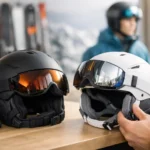
Goggle compatibility is one of the most overlooked parts of choosing a helmet. Take your own goggles to the shop if possible. Fit the helmet first, then the goggles, and check the join across the brow. A large exposed strip of skin, often called a gaper gap, is not just untidy-looking: it can be an icy weak spot in bad weather.
Just as importantly, make sure the goggle frame does not lift the helmet or pinch the bridge of your nose. Some combinations channel air neatly through the goggle vents; others encourage fogging when you are hiking a park feature or waiting in a lift queue. There is no substitute for trying the actual pairing, particularly if you use a larger-framed cylindrical or spherical lens.
Shell construction, weight and real-world trade-offs
Most snow helmets use either an in-mould construction, where the hard outer shell is bonded to the impact-absorbing foam, or a tougher hardshell design with a separate outer shell. In-mould helmets are generally lighter and often better ventilated, which is attractive for riders who run warm or tour away from the lifts. Hardshell options can feel more substantial and are frequently a sensible choice for regular park use, rental environments or riders who are hard on their kit.
Neither construction is automatically safer simply because of its name. Certification, fit and the condition of the helmet are the starting points. Weight does matter, however. A few grams may not register in a shop, but a heavy helmet can become tiring over a full day, especially for smaller riders or anyone returning after a neck injury. Conversely, chasing the absolute minimum weight can mean giving up warmth, durability or useful adjustment.
Fixed ear pads usually offer a warmer, quieter ride and a more enclosed feel in stormy conditions. Removable pads make a helmet more versatile for spring slush and indoor snow centres. If you wear hearing aids, use headphones or dislike pressure around your ears, spend extra time assessing this area. Comfort is personal, and it is better to find that out before the first snowy morning of your holiday.
Ventilation should match how and where you ride
British riders often encounter a broad range of temperatures in one trip. A helmet with adjustable vents gives useful control when a bluebird afternoon follows a freezing start, or when a long traverse and a few hikes leave you overheating. For piste-focused riders, fixed vents may be perfectly adequate and can offer a simpler, quieter set-up.
More vents are not always better. Openings can admit cold air, let in snow during a storm and create a noticeable chill on a chairlift. Look at where the vents sit and whether they can be operated with gloves on. Also consider how they work with your goggles. A helmet designed to draw warm, moist air up and away from the lens can make a meaningful difference to visibility, especially in the flat-light conditions that demand a clear view of changing snow.
Features worth paying for – and those to question
A good closure system, washable liner, secure goggle clip and practical vent adjustment are features most riders will appreciate every week. Audio-compatible ear pads can be useful, though they should never prevent you hearing other riders, lift announcements or changing conditions around you. A helmet carrying a recognised impact-management system may also justify the additional cost if it fits well and sits within budget.
Treat built-in visors with a little caution. They can be excellent for riders who wear glasses and struggle to find comfortable goggles, but they are more specialised than a conventional goggle-and-helmet set-up. Check the visor seal, lens options and whether you can comfortably use it in snow, flat light and bright spring conditions.
Colour is not a safety feature, but it can still be a practical choice. A bright helmet is easier for friends and family to spot in a busy lift area or among trees. Matte finishes can look smart but show scratches quickly; gloss may be easier to wipe clean. These are small considerations, yet a helmet is one of the few pieces of equipment you use on every run.
When to replace a snowboard helmet
Replace a helmet after a significant impact, even if the outer shell looks fine. The foam liner is designed to absorb energy and may be compromised without visible damage. Follow the manufacturer’s guidance after any crash, and be particularly cautious if the helmet has hit a rail, rock, tree or hard-packed piste.
Age, storage and wear also count. Cracked shells, compressed foam, damaged straps, loose fittings or a degraded liner are all reasons to retire it. Avoid leaving a helmet baking in a car, storing it beside a radiator or attaching cameras and accessories in ways the manufacturer does not approve. Second-hand helmets are difficult to assess because their impact history is unknown, so they are rarely a wise saving.
The right choice is the helmet you barely notice while riding – until conditions turn, speed builds or an unexpected fall reminds you why it was there. Try several, take your goggles, and give the fit more attention than the colourway. Your future days on snow are worth that extra ten minutes in the shop.
Related Posts:
Categories: Resort News & Reports
Leave a Reply
You must be logged in to post a comment.