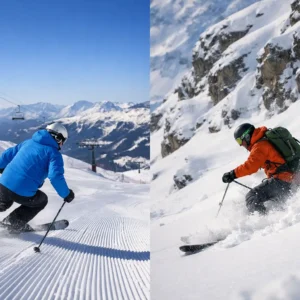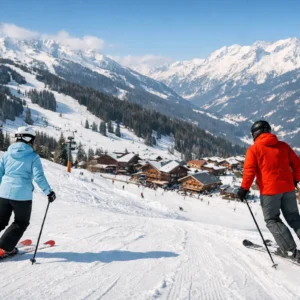
A good ski watch should earn its place under your jacket cuff. For some skiers, that means a clear record of vertical metres and top speed at the end of the day. For others, ski watches are about safety and confidence: reliable navigation when visibility drops, a route back to the lift, or an SOS function when a day in the backcountry does not go to plan.
The best choice depends less on how many sports modes sit in the menu and more on how, where and how often you ski. A week based around lift-served pistes in the Three Valleys asks different things of a watch than a touring weekend in the Cairngorms or a season spent chasing powder away from marked runs.
What ski watches are genuinely useful for
At their best, ski watches turn the detail of a mountain day into information you can use. GPS tracking records your route, while an altimeter estimates the vertical you have skied. Many watches automatically identify downhill runs and lift journeys, then present a total distance, descent, moving time and maximum speed.
These figures are entertaining, particularly when comparing a full day with friends or seeing how much ground a large resort really covers. They are not always perfectly precise. Automatic run detection can mistake long traverses, queueing or a gondola journey for skiing, and vertical totals vary with GPS signal, barometric pressure and the manufacturer’s software. Treat them as a useful record rather than a race official’s timing sheet.
Navigation is often more valuable than statistics. Watches with downloadable topographic maps, a clear breadcrumb track and turn prompts can be genuinely reassuring on a touring route or when moving between valleys in unfamiliar terrain. They do not replace a paper map, local knowledge, avalanche equipment or sound decision-making. Nor should a tiny screen persuade anyone to follow a route beyond their ability or the day’s conditions.
The features that matter most on snow
GPS and altitude accuracy
A ski watch needs dependable satellite reception in steep-sided valleys, tree-lined pistes and mixed weather. Multi-band GPS, found on many higher-end models, can improve track accuracy where signals are reflected by cliffs or buildings. It is a worthwhile feature for skiers who tour, race, analyse routes or simply dislike seeing their recorded track cut straight through a mountainside.
For resort skiing alone, standard GPS is usually sufficient. An altimeter, ideally barometric as well as GPS-based, is more relevant to vertical tracking. Barometric sensors need occasional calibration, particularly after major weather changes, but tend to produce more credible elevation data over a long day.
Maps that work without a phone signal
Offline mapping is the dividing line between a fitness watch that happens to have a ski mode and a proper mountain tool. Check that maps can be downloaded before travelling, that the watch has enough storage for the area you intend to use, and that the screen remains readable at a glance.
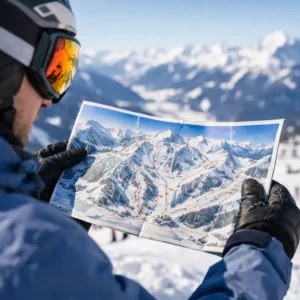
Resort piste maps are helpful, but not all platforms offer them for every destination. Contour mapping is more useful beyond the lifts, where slope angle, terrain shape and the ability to retrace a route matter. Remember that consumer mapping is not a substitute for current avalanche information or a guide in complex glaciated terrain.
Battery life in cold conditions
Battery claims are usually measured in benign conditions, not after six hours in sub-zero temperatures with GPS running, the backlight active and phone notifications buzzing away. Cold affects all rechargeable batteries, so look beyond the headline figure.
For a straightforward ski holiday, aim for a watch that can track a full day using GPS without anxiety. If you want maps, multi-band GPS, music or always-on display settings, allow more margin. Multi-day touring calls for a watch with a serious GPS battery mode, the option to carry a power bank, and a charging cable that is not easily misplaced in a chalet.
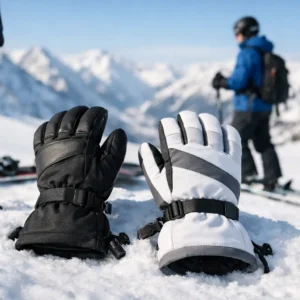
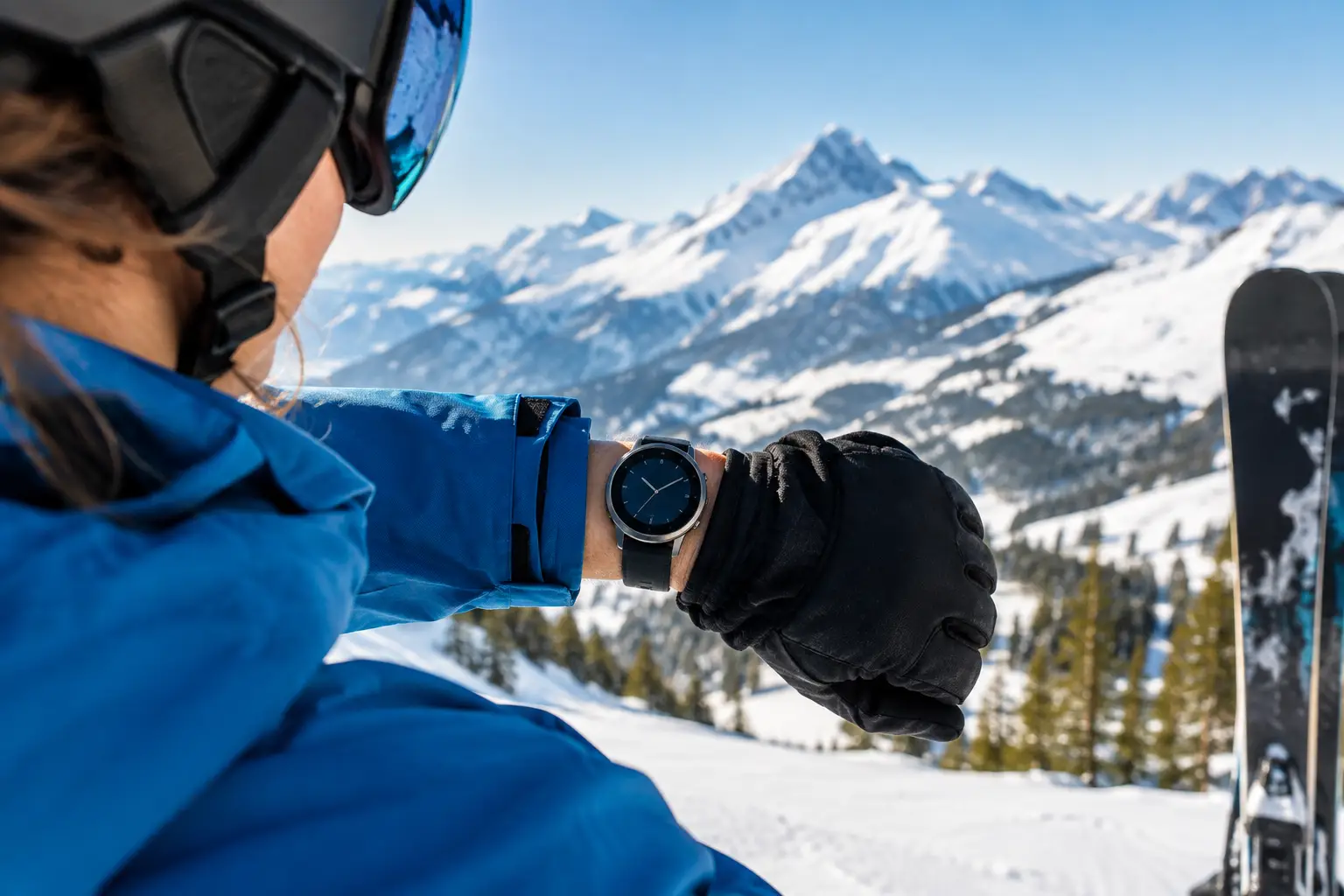
Keeping the watch under a glove cuff rather than fully exposed can make a modest difference in bitter weather. It also protects the screen from knocks on chairlift bars and ski edges.
A screen and controls you can use with gloves on
Touchscreens are excellent for maps and everyday use, but snow, wet gloves and cold fingers can make them frustrating. Physical buttons remain the most reliable way to start an activity, mark a point or scroll through data on the move. The strongest designs combine both: buttons for essential controls and a touchscreen for detailed navigation when you stop.
Display size is a trade-off. A large AMOLED screen makes mapping and notifications easy to read, but can consume more power. A transflective display may look less vivid indoors, yet remains highly legible in bright alpine sun and is often kinder to battery life. Try the watch on before buying if possible. It needs to sit comfortably beneath a jacket cuff and feel secure when you pole plant or ride through chopped-up snow.
Do you need health and performance data?
Most premium watches now offer heart-rate monitoring, training load, recovery guidance, sleep tracking and pulse oximetry. For committed skiers, these can add useful context. A hard day of bumps, off-piste laps or ski touring is proper physical work, and recovery data may encourage a more sensible easy day when fatigue is building.
There are limits. Wrist-based heart-rate readings can be less reliable when the sensor is cold, the watch is loose, or you are gripping poles hard. Calorie estimates are approximations, and altitude readings from consumer sensors should not be treated as medical advice. The value lies in spotting personal trends over time, not obsessing over one unusually high or low number.
For a skier already using a watch for running, cycling or gym work, staying within the same platform can make sense. Your winter training, summer fitness and time on snow then sit in one record. If skiing is the only activity you plan to track, paying for every advanced training metric may be unnecessary.
Which type of ski watch suits your skiing?
There is no single best option because the right balance changes with your mountain habits.
- Resort holiday skiers should prioritise automatic ski tracking, a clear display, reliable full-day battery life and straightforward syncing to a phone. Detailed offline maps are useful but not essential for everyone.
- Frequent seasonnaires and serious piste skiers may value accurate vertical totals, quick controls, durable construction and training features that work across the rest of the year.
- Ski tourers and splitboarders should place offline topographic maps, route navigation, long GPS battery life, barometric altitude and safety-focused features above lifestyle extras.
- Mountain athletes and guides are likely to benefit from multi-band GPS, extensive mapping, advanced battery management and compatibility with external sensors, accepting that these watches tend to be larger and more expensive.
Snowboarders should make the same judgement, with one practical extra consideration: a watch can catch against a glove or cuff more easily when fastening bindings. A lower-profile case and a tough strap are worth considering. Automatic activity detection is also less consistent for snowboarders on flatter connecting runs, so check whether the platform records snowboard mode separately and sensibly.
Smartwatch extras: useful, but not the main event
Contactless payment is handy for a coffee at the mid-mountain hut when you would rather leave your wallet in the hotel. Notifications can help with meeting friends, delayed transfers and family logistics. Music storage is pleasant on a solo lift ride, although many skiers prefer to keep one ear free for lift staff, other slope users and changing conditions.
Calls, messages and a bright screen can quickly turn a mountain watch into another device competing for attention. The mountains are one of the few places where being less available has real appeal. Set the essentials, silence the rest, and let the watch serve the day rather than interrupt it.
Set it up before you travel
Do not wait until the first lift queue to learn the menus. Update the watch, download maps over Wi-Fi, select the right ski or snowboard activity, and test GPS recording locally. Set data screens with only the figures you will actually use, such as elapsed time, vertical descent, altitude and battery percentage.
If you are relying on navigation, practise loading a route and retracing it. Check emergency functions carefully too. Incident detection, live location sharing and SOS services can be useful, but their availability may depend on phone coverage, a subscription, a paired handset or local rescue arrangements. A watch is an additional layer, not a replacement for telling someone where you are going.
The right watch should fade into the background until it is needed: recording a memorable day, confirming how far you have travelled, or helping you stay oriented when the cloud rolls in. Choose for the skiing you actually do, leave a little battery in reserve, and spend more time looking up at the mountain than down at your wrist.