World record sit-ski expedition cut short after one week in Antartica
Darren Edwards, the world record-breaking adaptive adventurer, has announced that after encountering insurmountable challenges he and his ‘Redefining Impossible’ expedition team have cut short their 222km sit-ski expedition to the South Pole. Darren Edwards said: “We’re not going to reach the…
Skier & Snowboarder
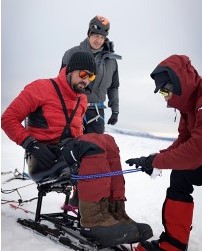
Darren Edwards, the world record-breaking adaptive adventurer, has announced that after encountering insurmountable challenges he and his ‘Redefining Impossible’ expedition team have cut short their 222km sit-ski expedition to the South Pole.
Darren Edwards said: “We’re not going to reach the South Pole. The distances we are doing each day, the amount of hours we are putting in each day, the terrain that we’re trying to get through, it’s so incredibly tough and the reality is that at the speed we are going, we will not reach the South Pole in time.
PHOTO: Matthew Biggar
“We don’t have the rations to keep going, we can’t afford a resupply and members of the team are carrying injuries. The reality is we are not covering enough distance each day, so we are far too slow to reach the Pole in time and that hurts. But we learn more from our failures then we do our successes.”
British adaptive explorer Darren Edwards, who is paralysed from the chest down, set off from the UK on 3 December and arrived in Antarctica on 7 December with expedition team members Matthew Biggar, Lucy Shepherd and Dwayne Fields.
Darren started his ‘Redefining Impossible’ world record attempt to become the first person to sit-ski 222km across Antarctica on 10 December with the aim of reaching the South Pole two weeks later on Christmas Day in an attempt for the longest sit-ski in the history of Polar exploration.
One week into the expedition, on the evening of Wednesday 17 December the team collectively made the difficult decision to cut short the expedition, announced via Darren Edward’s Instagram account the following day. The team were picked up by airplane on 18 December and flown back to the safety of one of Antarctica’s manned stations via a visit (by airplane) to the South Pole.
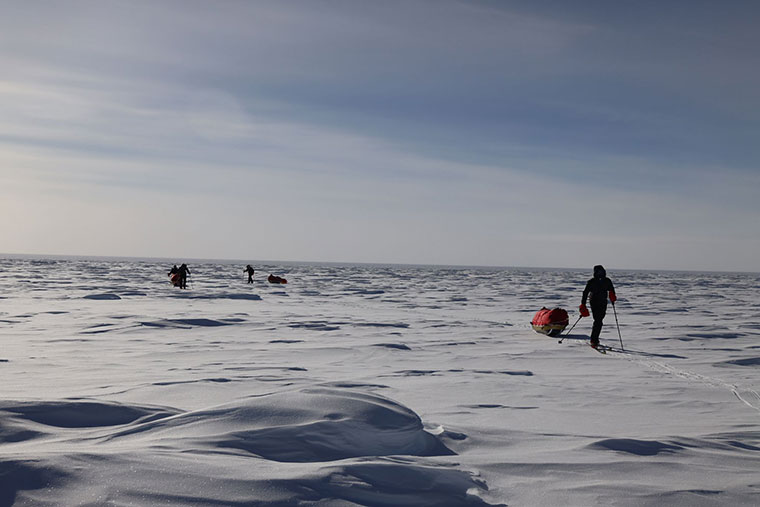
One of the biggest challenges the team faced during the expedition was battling Antarctica’s Sastrugi – these are sharp, wave-like ridges and grooves carved into the snow surface by relentless, strong winds, acting like snow dunes but aligned with the wind, making travel by ski extremely difficult and almost impossible by sit-ski.
The team had a window of three weeks to reach the South Pole, however the adverse weather conditions and the incredible challenge of both skiing and sit-skiing across rock hard Sastrugi, through the world’s most inhospitable desert, meant that the expedition team could not cover enough ground each day. Falling further behind their target distance each day meant that the team would have had to extend the expedition by up to two weeks to reach the South Pole. Without the rations needed to extend the expedition or the funds to fly in a resupply, the team made the difficult decision to call an end to the expedition on 17 December.
The Redefining Impossible expedition to the South Pole was organised by Darren Edwards, who suffered a spinal injury in 2016, to challenge perceptions of disability and empower others to redefine the impossible in their own lives.
Darren Edwards remains the only person to attempt to sit-ski to the South Pole from 88° South – 222km from the South Pole – a place no one with a spinal cord injury has every ventured before.
Darren Edwards said: “From the moment we set off from 88° South (222km from the Pole) we’ve battled Sastrugi. The snow is like sand paper, so every push of my poles gets me only six inches further forward, whereas normally I can push and glide, and we’re down to temperatures of minus 45 which is extreme even for Antarctica. As a team we’ve battled through every minute and every hour. It’s been the toughest physical and mental challenge of my life.
“While we haven’t made it to the South Pole, for me the success of this endeavour has been to chart an area where sit-ski has never been and where someone with a Spinal Cord Injury has never been. In a landscape that feels incredibly hostile to disability and hostile to a sit-ski, I’m so thankful for having my team mates Matthew, Lucy and Dwayne alongside me, who have each had their own mental and physical battles to fight through each day, just like me.”
Darren is continuing to raise £100,000 for the charity Wings for Life which seeks to find a cure for Spinal Cord Injury, and funds research and clinical trials globally.
We use cookies to make this site work and, with your consent, to measure performance and personalise content. You can accept all cookies, reject non-essential cookies, or choose which to allow.
These cookies are essential for the website to function and cannot be switched off. They are usually set only in response to actions you take, such as setting your privacy preferences, logging in, or completing forms.
Analytics / Performance
These cookies help us understand how visitors use the site so we can measure and improve performance. The information is aggregated and, where the exemption applies, used only on a first-party, statistical basis.
Marketing & Advertising
These cookies are used to build a profile of your interests and show you relevant adverts on this and other sites. They are only ever set with your explicit consent.