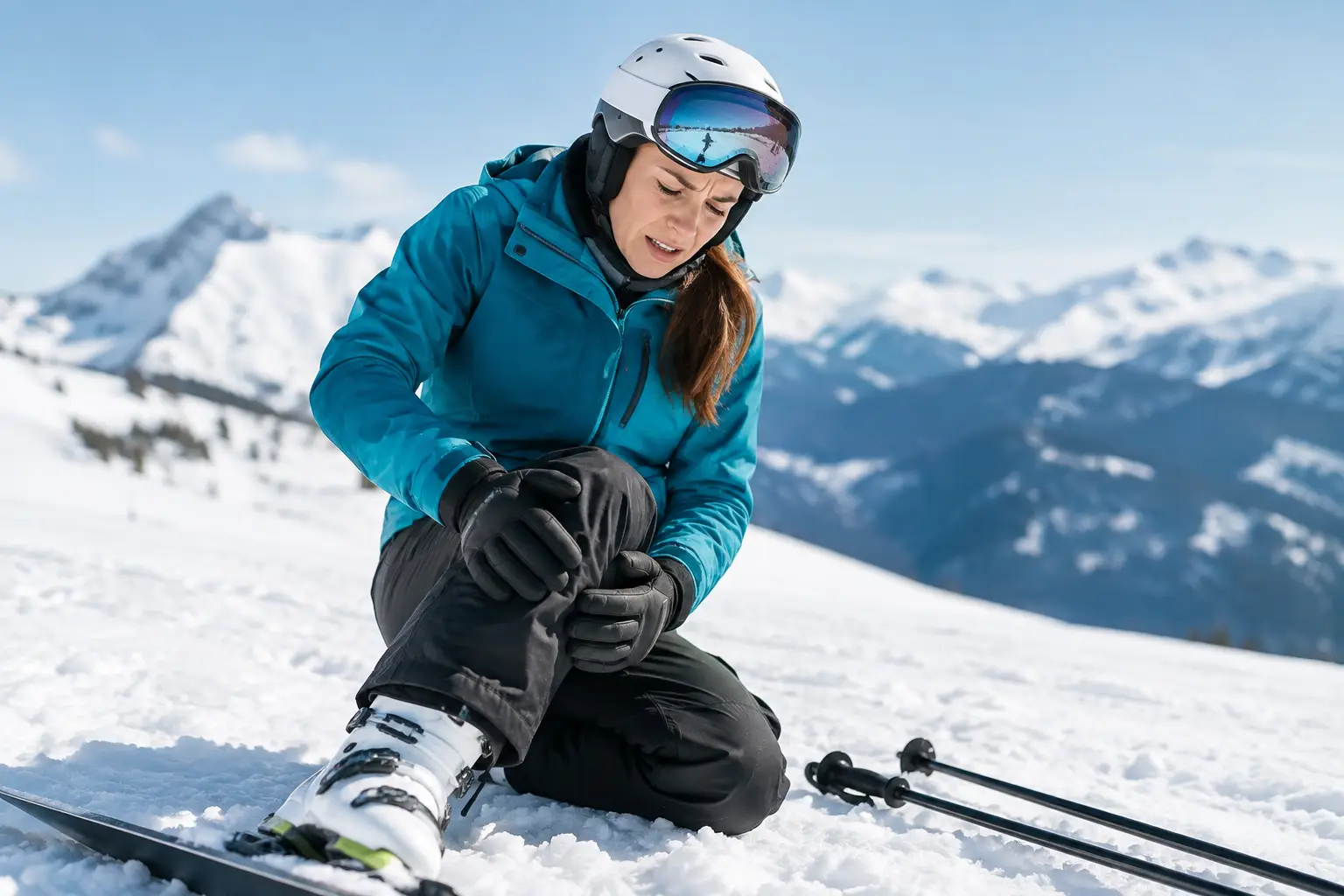
A sore knee at the end of a big mountain day is common enough to be shrugged off. But what causes ski knee pain is not always simply ‘getting older’ or having skied too many laps. The knee takes repeated load from pressure changes, turns, uneven snow and the occasional defensive manoeuvre. Working out when it hurts, where it hurts and what was happening on the slope usually gives a far better clue to the cause.
For UK skiers, there is another familiar factor: going from a desk, commute and perhaps a few sessions at an indoor slope straight into six consecutive days in the Alps. Your enthusiasm may be holiday-ready before your legs are.
What causes ski knee pain on the slopes?
Skiing places the knee in a demanding role. It flexes and extends constantly, absorbs terrain, and helps direct force from the hips and feet through the ski. A well-balanced skier shares that work across the whole lower body. When technique, fitness, equipment or snow conditions upset that balance, the knee often picks up the bill.
Pain is not one diagnosis. An ache around the front of the kneecap after long days can have very different roots from a sharp twist-related pain on the inside of the joint. The useful question is less ‘can I ski through it?’ and more ‘what is loading this part of my knee?’
Fatigue and a back-seat stance
Fatigue is one of the most common contributors, particularly late in the day or later in the holiday. As the quads tire, many skiers sit back and let their hips drift behind their feet. That stance makes the thighs work harder and can increase pressure around the kneecap.
It is particularly noticeable in chopped-up pistes, spring slush and heavy snow, when the skis need active management. Rather than forcing a final run when form has gone, a shorter day can be the decision that saves the rest of the week. It is not a lack of commitment – it is sensible mountain management.
A forward, athletic stance does not mean leaning aggressively over the ski tips. Think ankles flexed, shins in contact with the boot tongues, hips above the feet and hands ahead. If maintaining that position feels impossible, fatigue, boot fit or both may be part of the picture.
Technique that twists or overloads the knee
The knee is designed mainly to bend and straighten. It does tolerate some rotation, but it is less happy when the ski is gripped by the snow while the body twists above it. Catching an edge, skiing defensively in icy conditions or trying to muscle a turn with the legs rather than guiding it from the hips can all create this torque.
Over-rotation is a frequent issue for progressing skiers. Turning the shoulders downhill or swinging the upper body to initiate the next turn can leave the legs, skis and knee trying to catch up. The result may be discomfort on the inside or outside of the joint, especially after a day of short turns or busy, scraped-off pistes.
An on-snow lesson can be genuinely useful here, even for experienced skiers. A good instructor will not merely tidy up the look of a turn. They can identify whether you are pushing the tails, collapsing inward at the knee, standing too wide, or relying on one stronger leg to do most of the work.
Boots, bindings and ski set-up
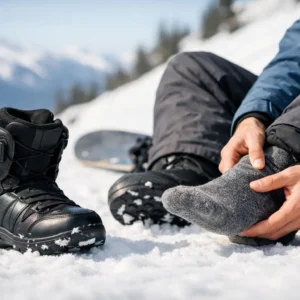
Poorly fitted boots can contribute to knee pain more readily than many skiers expect. If a boot is too roomy, the foot can move inside it and you may tense the legs to regain precision. If it is excessively stiff or restrictive for your strength, mobility and skiing style, it can make it difficult to flex naturally through the ankle. Either scenario can move excess stress higher up the chain.
Alignment matters too. Cuff adjustment and footbed support can affect how the knee tracks over the foot. A skier whose knees consistently fall inward, or who cannot stand balanced on a flat ski, may benefit from assessment by a reputable boot fitter. This is not a case for randomly tightening buckles or changing binding settings in resort.
Bindings should be correctly adjusted by a qualified technician for the skier, boot and equipment. Incorrect release settings may increase injury risk in a fall, while worn or poorly maintained equipment can undermine confidence and encourage tense skiing. Ski length and stiffness are also worth considering: a demanding ski can be brilliant at speed but punishing when your fitness or conditions call for something more forgiving.
Fitness gaps, strength and mobility
Skiing is an intermittent, high-load sport disguised as a holiday. Strong quadriceps help, but they are only one part of the answer. Glutes and hamstrings support hip control, calves and ankles help manage pressure into the boot, and the trunk provides the stable platform from which the legs can move.
When the hips lack strength or control, the knee may drift inward during a turn. When ankle mobility is limited, it may be harder to stay centred in the boot. Previous injury, a big difference in strength between legs and long periods of sitting can all make this more likely.
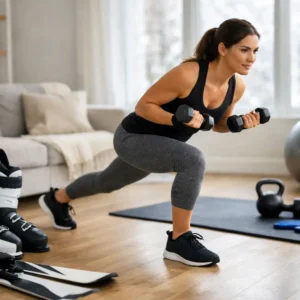
A sensible pre-season programme need not be elaborate. Squats or sit-to-stands, split squats, step-ups, calf raises, hamstring work and single-leg balance are practical foundations. Build volume gradually and practise the sort of sustained leg effort skiing requires. Two or three consistent sessions each week in the run-up to a trip will generally do more than one punishing gym session three days before departure.
Terrain, snow and holiday pacing
Hard-pack, moguls and variable off-piste snow all ask more of the knees than a freshly groomed blue run. In crud, the ski can be knocked off line; in moguls, the knee repeatedly flexes under load; on ice, a tense skier may twist to regain control. None of this means you should avoid challenging terrain, but it does mean matching your ambition to your energy level and technique.
Long lift queues, a rushed lunch, dehydration and a celebratory beer at altitude can all affect decision-making and muscle function. Pace the day as you would any demanding activity. Warm up with easier laps, take a proper break before form deteriorates, and do not judge your capacity by the group’s fastest skier.
Common injury patterns behind ski knee pain
An acute twisting fall can injure structures inside the knee, including the medial collateral ligament (MCL), anterior cruciate ligament (ACL) and meniscus. These injuries are not interchangeable, and symptoms vary. Some people hear or feel a pop; others mainly notice swelling, instability or difficulty fully straightening the knee.
Pain at the front of the knee that develops gradually is often linked to overload around the kneecap, commonly described as patellofemoral pain. Pain on the inside may involve the MCL or, in some cases, the meniscus. Joint-line pain, catching or locking deserves particular care. Osteoarthritis can also become symptomatic during a ski holiday, especially after prolonged loading, although many people with arthritis ski very successfully with the right preparation and medical guidance.
It is tempting to diagnose yourself from the location alone. Avoid that. The knee has overlapping structures, and pain may originate from the hip, lower back, foot or boot interface rather than the joint itself.
When to stop skiing and get help
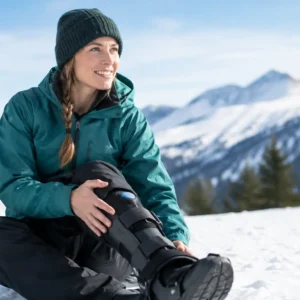
Minor muscular soreness that eases with rest may settle, but certain signs should move the decision away from ‘one more run’. Stop skiing and seek urgent medical assessment if you have significant swelling after a fall, cannot bear weight, feel the knee give way, cannot fully bend or straighten it, or have a visibly altered joint shape.
A locked knee, a painful pop followed by rapid swelling, numbness or a cold foot also need prompt assessment. In resort, use the local medical service rather than trying to manage a potentially serious injury through the remainder of the holiday.
For pain that is persistent but not acute, a physiotherapist or sports medicine clinician can assess movement, strength, previous injury and equipment factors. That is especially worthwhile if the same pain returns on every trip, worsens during ordinary walking or affects your confidence on snow.
Reducing knee pain before the next ski day
If the knee is mildly sore without a clear injury, reduce the load first. Choose easier terrain, shorten the day and avoid the combination of fatigue, poor visibility and demanding snow. Gentle movement may feel better than complete inactivity, but pain should not be escalated simply because you are on holiday.
Check the practical basics: boots comfortably buckled, skis appropriate for the day, bindings professionally maintained, and enough food and water on board. Then look at the bigger picture. More balanced skiing, a little pre-trip conditioning and the confidence to call last lift before your legs collapse will often make the following day more enjoyable.
The best ski days are rarely won by stubbornness. Listen early to a knee that is asking for a change, then give it the preparation, technique and professional attention it needs to keep you enjoying the mountains for many seasons ahead.