A piste covered edge to edge in February may look like a simple promise of a good day on skis or a board. Behind that surface sits a fast-moving technical operation: weather stations reading the mountain minute by minute, pumps moving vast volumes of water, and snowmakers deciding where each cubic metre of snow will make the biggest difference. Snowmaking technology trends matter to UK holidaymakers because they increasingly shape which runs open, how long resorts can trade and what the snow feels like underfoot.
The key point is not that snowmaking can replace winter. It cannot. But better systems are helping resorts make more snow during shorter cold spells, use less energy per cubic metre and preserve coverage where it matters most. For skiers and snowboarders weighing up a Christmas break, an Easter trip or a lower-altitude family holiday, that is useful information rather than industry background noise.
The shift from more snow guns to smarter snowmaking
For years, a resort’s snowmaking strength was often judged by the number of cannons or fan guns along its pistes. Capacity still matters, especially when a cold window arrives and an area needs to build a base quickly. The more meaningful measure now is how intelligently that network is designed and run.
Modern installations connect automated weather stations, hydrants, pumps and individual snow guns through central control software. Operators can see temperature, humidity, wind and water pressure across the ski area, then adjust output without sending teams up and down the mountain to alter every machine by hand. In the best systems, the software recommends the most efficient settings, while experienced snowmakers retain control over the calls that affect piste priorities and snow quality.
This is especially valuable during marginal conditions. Snowmaking depends on wet-bulb temperature, which combines air temperature and humidity. Dry air can allow useful production at temperatures that look unpromising on a standard thermometer, while damp air can make a seemingly cold night ineffective. Accurate local readings mean a resort can make snow when conditions genuinely allow it, rather than wasting water and power chasing a poor window.
For riders, the result is often less dramatic than a line of cannons firing in a blizzard, but more valuable. It can mean a consistent route back to the village, a properly connected beginner area or a park that stays open through a busy school-holiday week.
Higher efficiency is becoming the real contest
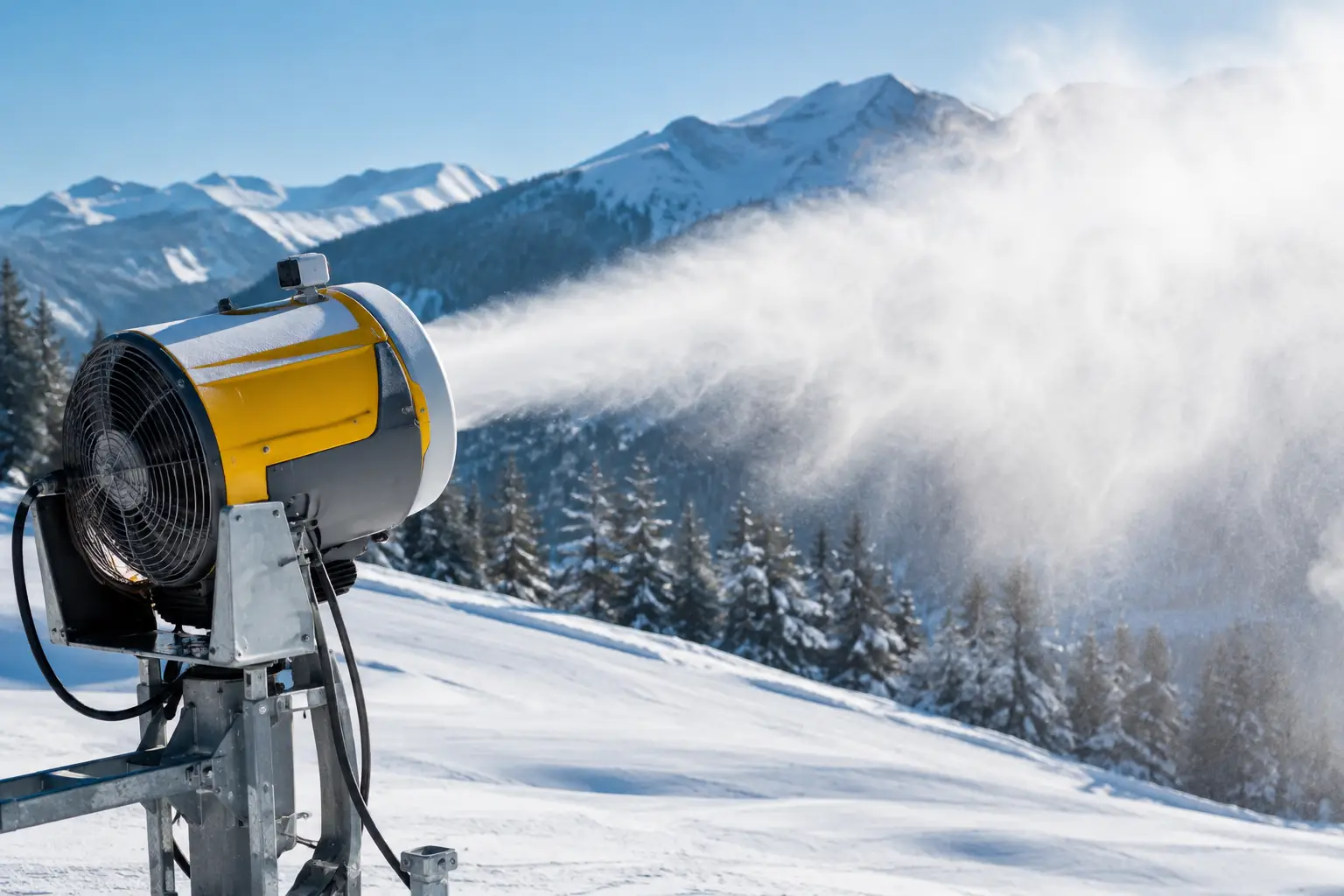
Fan guns remain the familiar sight on Alpine pistes, but their design continues to improve. More efficient fans, better nozzles and finer control of air and water ratios can reduce the energy required to produce usable snow. Pole-mounted lances, which use pressurised water and compressed air but generally consume less electricity than fan guns, are also part of the mix where conditions suit them.
Neither system is automatically superior. Fan guns can offer high output and flexibility in the right conditions, while lances can be highly economical for sustained production. Terrain, water pressure, wind exposure, the length of cold spells and local electricity arrangements all influence the choice. Resorts with extensive, established infrastructure may improve gun efficiency and automation rather than replace every machine.
The bigger trend is system-wide efficiency. Pumping water uphill is energy-intensive, so variable-speed pumps and carefully managed pipe networks are increasingly important. Resorts are also enlarging or improving storage reservoirs, allowing them to capture water when it is plentiful and make snow rapidly when temperatures drop. The aim is to avoid running every component at maximum output for longer than necessary.
That does not make snowmaking impact-free. It is an industrial operation in a sensitive landscape, and electricity demand, water abstraction, construction work and visual impact deserve scrutiny. Better technology can lower resource use per unit of snow, but it does not remove the need for transparent environmental planning.
Cleaner power changes the calculation, but not the question
Several mountain regions are pairing snowmaking upgrades with renewable electricity contracts, hydroelectric generation or on-site solar where terrain permits. This can reduce the carbon intensity of production, particularly when systems are scheduled around low-demand periods or cleaner grid supply.
However, claims need context. A resort running efficient snow guns on lower-carbon power is making a meaningful improvement; it is not producing snow from thin air. Water must still be stored, transported and eventually returned to the catchment. Sensible resorts explain their water sources, seasonal storage and energy use rather than relying on broad green language.
Snow depth data is changing how pistes are prepared
One of the most practical snowmaking technology trends sits beneath the groomer rather than beside the piste. Snow-depth measurement systems use GPS, terrain mapping and sensors fitted to piste bashers to compare the current snow surface with a summer ground model. The driver can see where the base is thin and where snow has accumulated too deeply.
This changes snow management from educated guesswork to a more precise operation. A team can move excess snow from a drift-prone area to a worn bottleneck, protect a shallow section before rocks emerge, and avoid pushing valuable snow into places that do not need it. The benefit is considerable in early season, on busy valley runs and during thaw-freeze cycles.
For snowboarders, who quickly notice a narrow, scraped-out traverse or a lumpy end-of-day link, this can make the mountain feel better connected. For beginners, it helps maintain wide, predictable slopes where the quality of the surface matters as much as the number of open kilometres.
Snow farming is moving from novelty to useful tool
Snow farming involves stockpiling snow under insulating materials through the summer, then spreading it out for early-season pistes, Nordic tracks, ski-jump landings or event venues. It is not a solution for an entire major resort, but it has a clear role in targeted locations.
A stored pile can help create an early-season learning slope, secure a race course or guarantee a key lift-to-village link while colder weather arrives. It is particularly relevant to resorts trying to open reliably for a fixed event or school holiday without committing to widespread early snow production in uncertain temperatures.
There are limits. Snow must be made or collected in the first place, stored in a suitable location and moved with machinery. Insulating covers require investment and careful handling. Yet where it prevents repeated emergency snowmaking or protects a crucial strip of terrain, snow farming can be a practical part of the toolkit.
What this means when choosing a ski holiday
Snowmaking percentages are often quoted in resort marketing, but the number alone can mislead. A resort may have snowmaking across a large share of its marked pistes, yet the most useful question is whether it covers the strategic runs: nursery slopes, main home runs, valley connections and lifts that link separate sectors.
When planning a trip, look beyond a single snow-depth figure. Consider altitude, aspect, the strength of the piste network, whether a resort has several sectors at different heights, and its record of keeping key routes open in lean spells. A high north-facing bowl with limited snowmaking may ski beautifully after natural snowfall, while a lower resort with a well-managed artificial base can be the more dependable choice for a specific week.
Timing matters too. For a Christmas or New Year trip, strong snowmaking and high-altitude terrain provide useful insurance, though neither can guarantee a full mountain in a warm spell. By March and April, elevation and aspect usually carry greater weight, while snowmaking helps protect the lower-mountain routes needed to finish the day without downloading in a lift cabin.
The technology supports the mountain experience, not the other way round
The most encouraging development is a move away from treating snowmaking as a blunt instrument. Better forecasting, automated controls, efficient equipment and detailed snow-depth mapping allow resorts to concentrate effort where it protects the experience guests actually have on snow.
That should lead to more honest decisions as well as better pistes. Some lower runs may need to close earlier, while priority terrain is maintained properly. Some resorts will invest in summer activities alongside winter operations rather than pretending every slope can offer the same season it did decades ago.
For the UK skier or snowboarder, the smart response is to see snowmaking as one useful part of a resort’s winter resilience. Choose mountains with the terrain, altitude and operations that suit your dates, then enjoy the fact that a carefully managed base can turn a short cold spell into several very good days on snow.