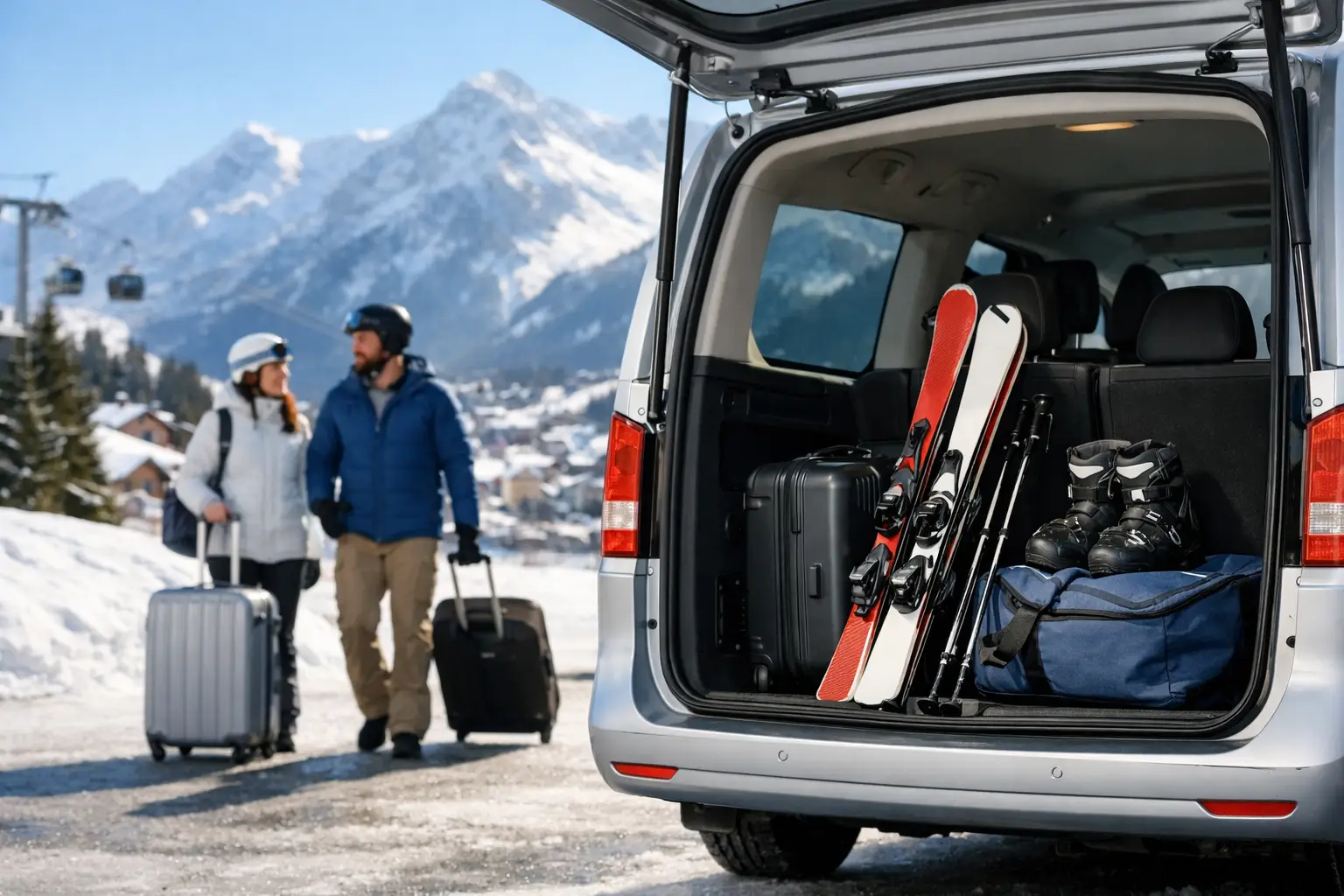
The transfer is rarely the bit of a ski holiday people get excited about. Yet after an early flight, baggage reclaim and a long queue for the loos at Geneva, it can define the mood of day one. Knowing how to book ski transfers properly means arriving at your resort with skis, boards and patience intact – rather than discovering your shared minibus has three more airport stops and no room for your boot bag.
For UK skiers and snowboarders, the right choice comes down to more than the headline price. Journey time, luggage policy, road conditions, flight timings and where the vehicle can actually drop you all matter. A little planning here protects valuable piste time later.
Start with the route, not the cheapest quote
First establish the airport-to-resort journey in realistic terms. Transfer times shown online are often based on clear roads and a direct run. In peak weeks, particularly Saturday changeover days in the Alps, traffic around Geneva, Lyon, Grenoble, Chambéry and Turin can add significant time. Snow chains, tunnel queues and weather closures can do the same.
Consider the arrival airport and resort together before booking. Geneva to Chamonix is commonly around 1 hour 15 minutes in good conditions, while Geneva to the Three Valleys or Tignes can be much longer. A late-afternoon landing for a resort three or four hours away may still work, but it leaves far less margin if the flight is delayed or roads are busy.
The same applies on the way home. A 06:00 collection for a 10:00 flight is nobody’s idea of a relaxed final morning, but an operator allowing a sensible buffer is usually making a judgement based on mountain roads, not trying to spoil breakfast. Ask what collection time is recommended for your specific flight, and be wary of firms promising an implausibly tight schedule.
Choose the transfer type that suits your group
There is no universal best option. Shared transfers can offer excellent value for solo travellers, couples and smaller groups travelling on popular routes. They are also an easy way to avoid the cost and logistics of hiring a car. The compromise is flexibility: you may wait for other arrivals, make additional drops, and have limited control over the route or departure time.
A private transfer costs more, but becomes compelling once a family or group fills most of a vehicle. It normally leaves when you are ready, takes you directly to the booked address and is especially useful when travelling with young children, a lot of equipment or an awkwardly timed flight. For groups of six to eight, compare the total private-vehicle price against individual shared seats rather than assuming shared is cheaper.
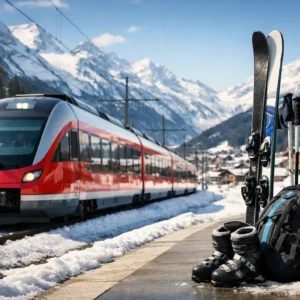
Coach transfers sit in the middle. On major routes they can be dependable and good value, particularly if the timetable matches your flight. The downside is that a fixed departure may be unforgiving if baggage is delayed. Public transport can also be a strong option for resorts with rail access, such as parts of Switzerland, Austria and France, but changing trains with a snowboard bag and a week’s luggage is a different proposition from travelling light.
How to book ski transfers with the right details
Booking early is sensible for school holidays, half-term, Christmas, New Year and the busiest Saturday dates. It is not only about availability. The best departure slots, private vehicles and larger vans often disappear first, while last-minute choices can be limited to costly or inconvenient options.
Before paying, have the essential information to hand. Transfer firms need accurate flight details so they can track changes where that service is included. They also need your accommodation name and full resort address. In pedestrianised villages, car-free centres and some high-altitude resorts, a door-to-door promise may actually mean the nearest permitted road, lift station or designated meeting point.
Make sure the booking records:
- airline, flight number, scheduled arrival time and airport terminal;
- the number of passengers, including infants and children who need a seat;
- skis, snowboards, ski bags, boot bags and any oversized luggage;
- the precise accommodation address, plus a contact number that works abroad;
- return-flight details and a collection point you can find in poor weather or darkness.
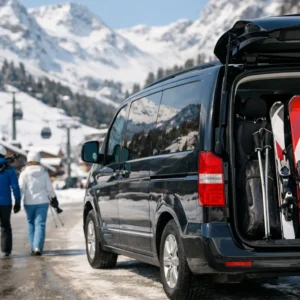
That equipment question is more significant than it looks. A minibus advertised for eight passengers may not comfortably take eight adults, eight suitcases and eight pairs of skis. Some operators include sports equipment, while others require it to be declared or charge extra. If you are taking a snowboard bag, confirm its permitted length rather than assuming it falls under standard luggage.
Child seats deserve the same attention. Some companies provide them free, some charge, and some ask parents to bring their own. If you need a rear-facing seat, booster or space for a travel buggy, get the arrangement confirmed in writing. Do not leave it to a note in the booking form.
Read the terms that matter on a snowy day
A polished booking page does not tell you how an operator behaves when conditions turn difficult. Read the cancellation, amendment, delay and weather policies before committing. The key question is not whether a company can track flights, but what happens if a delayed flight lands after the final shared-transfer departure or outside its operating hours.
Check whether the transfer is refundable, whether changes incur a fee, and how far ahead you can amend passenger or flight details. Low fares can come with strict terms that are perfectly acceptable if your plans are fixed, but less attractive when flights are booked separately and an itinerary has several moving parts.
Look at the practical inclusions too. Is there an extra charge for late-night travel? Are motorway tolls included? Does the price cover a return journey, or merely two separately priced single legs? For a shared service, ask about the maximum wait after landing and the possible number of stops. A stated journey time without these details does not tell the whole story.
Insurance is another useful backstop, not a replacement for sensible booking. Your travel policy should cover disruption and missed transport where appropriate, but policies differ. Keep transfer confirmations, receipts and any written communication if a delay leads to extra expense.
Build in margin at the airport
The smoothest transfer booking can still unravel if the airport meeting instructions are vague. Read them before departure from the UK, not while trying to connect to patchy airport Wi-Fi in ski gloves. Save the operator’s number, booking reference and meeting-point description offline, and make sure the lead traveller has access to them.
Allow time for passport control and baggage reclaim, especially at busy alpine gateways. Families, first-time flyers with ski bags and groups hiring equipment at the airport should avoid booking a departure that leaves moments after the scheduled landing time. A shared transfer departing 30 minutes after arrival may be feasible at a quiet airport with hand luggage; it is a gamble at Geneva on a February Saturday.
If your flight is delayed, contact the operator as soon as you know. Flight tracking is useful, but it cannot tell a driver that you are still waiting for an oversized ski bag or that your group has been redirected through a different arrivals hall. Keep messages concise, give the booking reference, and follow the operator’s stated process.
Think beyond the airport run
The final kilometre can be the awkward one. Snowfall, narrow lanes and resort traffic rules may prevent a vehicle reaching the chalet entrance. Ask whether your accommodation has a known winter drop-off point and whether the driver will help with luggage. This is particularly worthwhile for catered chalets, self-catering flats above village level and properties reached by steep access roads.
Departure day needs the same care. Confirm the pick-up time and place at least a day before travel, particularly if the weather has deteriorated. Pack the night before, return hired kit in good time and leave room for the fact that a driver may be unable to wait outside a busy hotel for ten minutes. A missed transfer is an expensive way to end a good week.
The best ski transfer is not necessarily the cheapest or the fastest on paper. It is the one that matches your flight, group, equipment and appetite for uncertainty. Book with proper margins, confirm the details that affect real mountain travel, and your holiday can begin where it should: looking up at the snowline, not down at a phone in an airport car park.