A ski can feel brilliant in the shop and disappointing on the hill if the binding is wrong. Knowing how to select ski bindings means looking beyond colour, price and the largest DIN number on the heel piece. Your bindings are the safety-critical connection between boot and ski: they must hold you securely through a carved turn, then release predictably in a fall.
For most holiday skiers, the good news is that the choice is more straightforward than the wall of bindings suggests. Start with your boots and ski, be honest about how and where you ski, and let a qualified technician carry out the final fitting and release test.
Start with boot and ski compatibility
Bindings do not fit every boot, and this is the first check to make before becoming attached to a particular model. Traditional downhill ski boots with an Alpine sole, known under the ISO 5355 standard, work with the broadest range of alpine bindings. GripWalk boots, now common on piste and all-mountain boots, have a rockered rubber sole that makes walking around resorts more comfortable. They require a binding clearly approved for GripWalk compatibility.
Touring boots add another layer. Some have pin inserts at the toe for tech bindings, while others are designed to work with alpine, GripWalk and touring systems. A boot may look close enough to fit, but sole shape, toe height and wear can alter how it engages with a binding. Never assume compatibility based on appearance alone.
Check the ski’s mounting system
Many piste-focused skis are sold with an integrated rail or plate and a matching binding. This is often an excellent route for intermediates and advanced resort skiers because the system is designed as a package, is easy for a shop to adjust, and usually offers more than enough performance. Buying a flat ski gives more freedom to choose, but it needs drilling and mounting correctly for the intended boot sole length.
Ski brakes need attention too. Choose a brake that is at least as wide as the ski waist, but not dramatically wider. As a rule, a brake around 5mm to 15mm wider than the ski is sensible. A brake that is too narrow may not deploy properly; one that is excessively wide can drag in deep edging or catch when skis are close together.
How to select ski bindings for your skiing
Think first about the snow you actually ski, rather than the skier you hope to become after three exceptional days in Chamonix. A recreational skier spending most of a week on groomed runs does not need the same binding as someone skiing steep off-piste lines, park jumps or long touring days.
For beginners and progressing intermediates, a light alpine binding with an appropriate release range is usually ideal. It should be straightforward to step into, reliable in variable resort conditions and matched to a moderate-flex boot. There is little benefit in paying for a very high DIN range or a race-derived construction when a lower-range model better suits your weight, ability and likely speed.
Confident intermediates and advanced all-mountain skiers often benefit from a sturdier binding with more elastic travel. This describes how much movement the binding can absorb before releasing. More elastic travel can help prevent unwanted release when skis are flexing hard through chopped snow, a heavy landing or an aggressive turn. It does not mean the binding should be set tighter than recommended.
Freeride skiers may prioritise a stronger platform, greater elastic travel and a brake width suited to wider skis. Park and freestyle skiers often value durable construction, consistent release and a low, predictable feel underfoot. Racers and powerful piste skiers may choose high-DIN bindings, but only because their size, force and skiing demands justify them, not because a high number is automatically safer or more prestigious.
DIN is not a strength rating
DIN is the figure most skiers notice first, and the one most commonly misunderstood. In everyday ski-shop language, it refers to the binding’s release-setting range. The correct setting is calculated from a combination of body weight, height, age, boot sole length, skiing ability and skier type. It is not a measure of talent, nor an invitation to turn the screws up after an unexpected release.
A binding should have a DIN range that comfortably includes your recommended setting, preferably not right at either extreme. Someone whose calculated setting is 6 will generally be better served by a binding ranging roughly around 3 to 10 than by a 10 to 18 model. The lower-range option is designed to operate accurately where they need it and is usually lighter and better value.
Release settings are a compromise between two risks: releasing when you need to stay connected to the ski, and failing to release in a fall where release could reduce injury risk. There is no universal setting that eliminates both. A trained technician uses the appropriate standard and calibrated equipment to set and test the binding for your boots. That final test matters as much as the setting shown in the window.
Look beyond the DIN window
Weight matters, especially if you carry skis through airports, train stations and sprawling Alpine villages. Yet shaving a few grams is not always the right call. A very light binding can be a superb match for a touring ski or modest-width all-mountain setup, while a heavier construction may give a more planted, confident feel on a powerful resort ski.
Pay attention to the toe and heel design, particularly if you ski in wet British spring conditions, heavy Alpine snowfall or resorts where you regularly walk through slush before clipping in. Good anti-friction devices under the toe, sensible clearance around the boot and a positive step-in action make daily use less frustrating. If possible, try stepping into the binding in the shop with your own boots. A mechanism that feels awkward on a clean showroom floor will not improve when it is packed with snow.
Stand height can also affect ski feel. Bindings and plates raise the boot above the ski to varying degrees. A little lift can help create edge angle on hard snow, particularly on narrow piste skis, but a tall setup is not automatically better. Most recreational skiers will notice compatibility, release reliability and overall ski balance well before they notice a few millimetres of extra height.
Alpine, hybrid and touring bindings
An alpine binding is the clear choice for skiers who use lifts all day and only venture beyond marked runs with an instructor or guide. It offers the most familiar step-in feel and dependable downhill performance.
Hybrid bindings aim to cover both lift-served skiing and uphill travel. Some use a traditional alpine-style toe for descents and a touring mode for climbing; others use a pin toe in walk mode but retain an alpine-style heel. They can be a sensible choice for a skier who genuinely tours several times each season, but they are heavier and more complex than a dedicated alpine binding.
Pin, or tech, bindings are built primarily for ski touring. They are impressively light and efficient on the ascent, but require boots with compatible inserts and demand more knowledge from the user. Downhill performance and release characteristics vary considerably between models. They are not simply lighter all-mountain bindings, and they are rarely the best first purchase for a skier whose touring ambitions are still theoretical.
Buy, mount and maintain with care
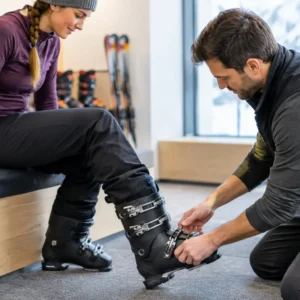
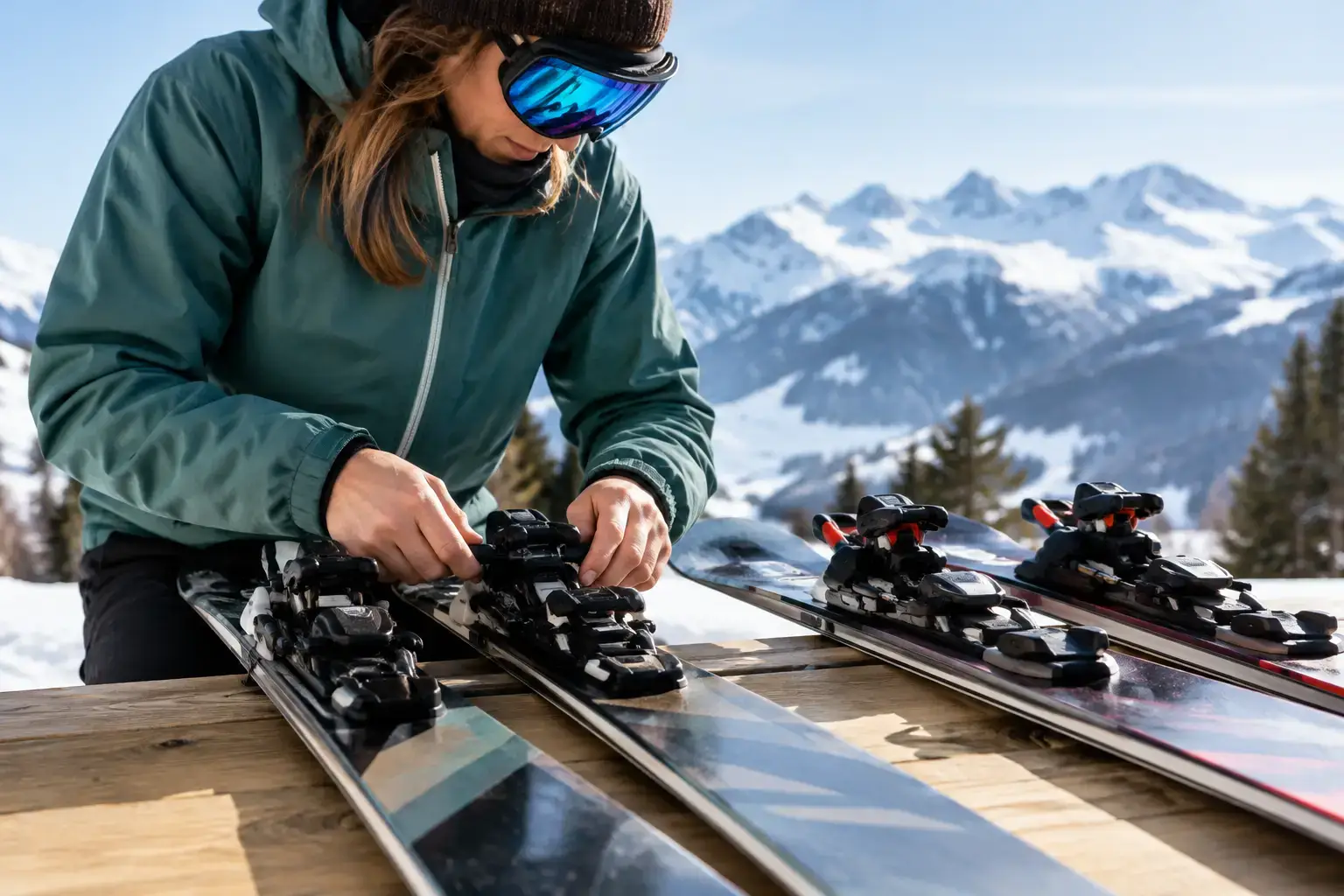
A reputable ski shop should ask about your boots, weight, height, age, experience, preferred terrain and how aggressively you ski. If those questions are skipped, look elsewhere. Correct mounting position, screw retention, forward-pressure adjustment, toe-height adjustment where applicable, and a machine release test are all part of a proper setup.
Second-hand bindings deserve particular caution. A lightly used, recent model from a known brand can be good value, but inspect it for cracked plastic, damaged brakes, corrosion, worn toe pieces and missing components. More importantly, check whether a shop will service and test it. Older bindings can fall outside manufacturers’ current indemnification lists, meaning many technicians will rightly refuse to adjust them.
Before every trip, inspect the bindings, clear snow from the boot sole before stepping in, and make sure the brakes retract and deploy freely. If you change boots, even to another pair in the same stated size, have the bindings checked again. Boot sole length and sole geometry can differ enough to require adjustment.
The best ski binding is not the burliest or most expensive one on the rack. It is the model that properly matches your boots, skis and real skiing, then is mounted and tested by someone who treats that connection with the care it deserves.