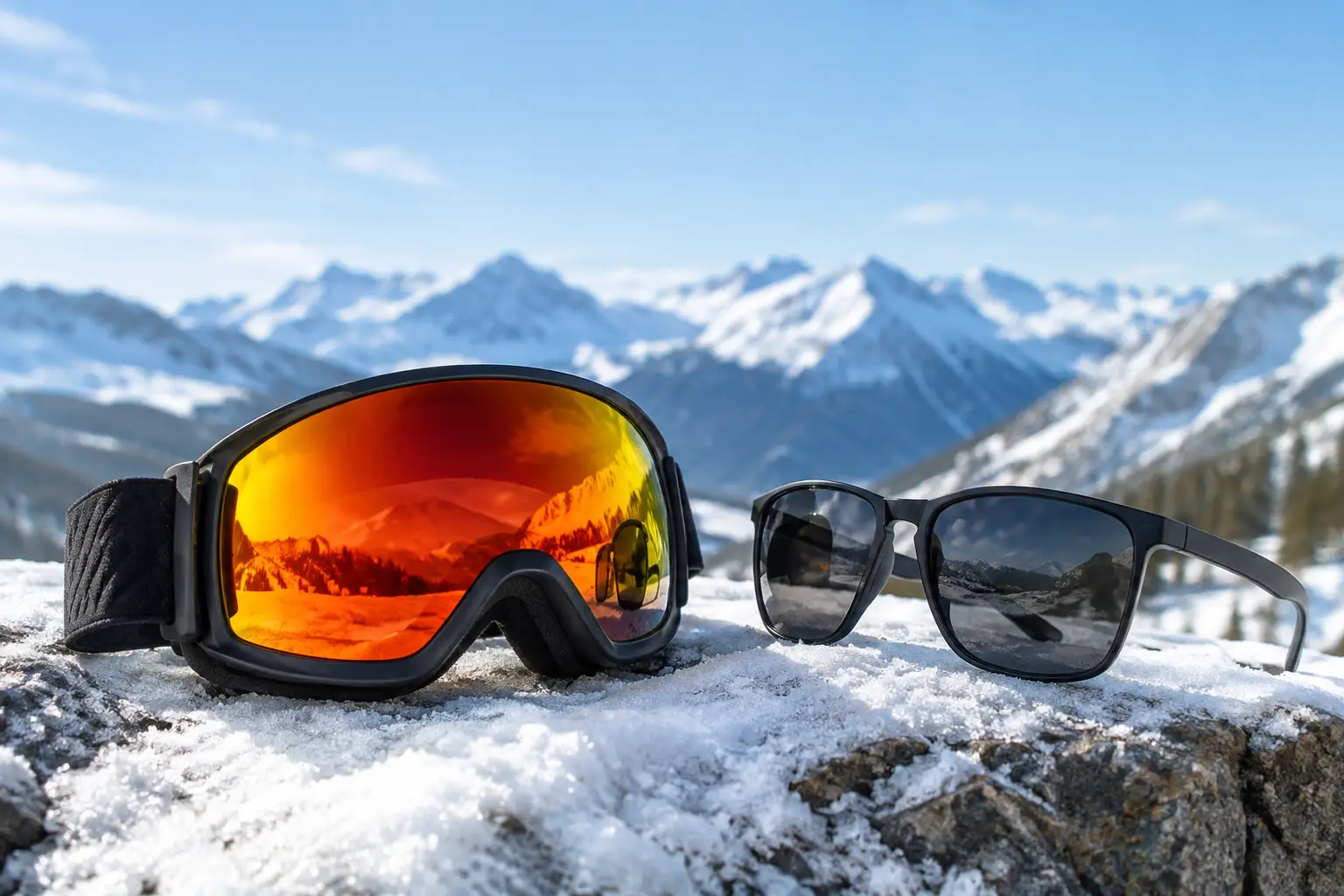
A bright morning above the tree line can make sunglasses feel like the obvious choice. Then a cloud rolls over the ridge, the temperature drops on the chairlift and the piste becomes a field of low-contrast ripples. The ski goggles versus sunglasses decision is not simply about style – it affects how well you read the snow, how comfortable you stay and how protected your eyes are when conditions change.
For most full mountain days, goggles remain the better all-round tool. That does not mean sunglasses have no place in a skier’s or snowboarder’s kit. In spring, on touring days or during long lunches on a sunny terrace, a good pair can be genuinely useful. The key is knowing where each option earns its place.
Ski goggles versus sunglasses: the core difference
Ski goggles create a sealed, wraparound barrier between your eyes and the weather. They are designed to work with a helmet, cover more of the face and keep wind, snow and airborne spray out. Their larger lenses also offer a much wider usable field of vision than most sunglasses, particularly at the edges.
Sunglasses are lighter, simpler and less claustrophobic for some riders. A quality wraparound sports model can provide excellent UV protection and work brilliantly in settled sunshine. But they leave gaps around the eyes, which matters when a run is fast, cold or busy with loose snow.
The distinction becomes most obvious on a chairlift. In sunglasses, a cold headwind can quickly make eyes water, while falling snow can sting and obscure vision. Goggles retain warmth around the eye area and protect against the wind chill that catches many British holidaymakers out after a mild start in resort.
Why goggles are the default for downhill skiing and snowboarding
A pair of goggles is not only for storm days. Even on clear days, they offer practical advantages that become more valuable as your speed increases or terrain gets more variable.
Better protection from wind, snow and impact
On a groomed blue run, sunglasses may feel perfectly adequate. Pick up pace, follow friends through chopped-up snow, or head into a tree-lined section after fresh snowfall, and the limits show quickly. Goggles are far better at stopping snow spray and icy wind from reaching the eyes.
They also provide broader protection from branches, lift debris and the occasional wayward pole. No eyewear makes skiing risk-free, but the lens area and secure fit of goggles offer more coverage when the mountain gets lively.
A clearer view of changing snow
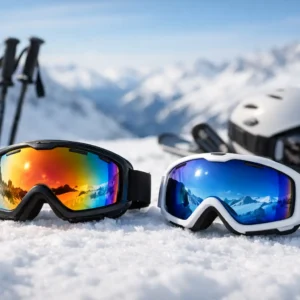
The most useful ski lens is not necessarily the darkest one. It is the one that helps you see definition in the conditions you actually face. This is where goggles have a substantial edge, because interchangeable-lens systems and photochromic options make it easier to adapt.
Lens tint is only part of the story. Visible light transmission, usually shown as a percentage or VLT, tells you how much light reaches your eyes. A low VLT lens is suited to very bright sunshine, while a higher VLT lens lets in more light for flat conditions, snowfall and late-afternoon laps.
On many Alpine holidays, weather can shift from bluebird to whiteout in an hour. A medium-VLT all-round lens is therefore often the sensible starting point for riders buying one pair of goggles. Enthusiasts who ski regularly may prefer a magnetic lens-change system, allowing a darker lens for the morning and a brighter one when cloud closes in.
Helmet compatibility and stable fit
Modern goggles are designed to sit neatly against a ski or snowboard helmet, with the strap holding them securely during bumps, jumps and falls. This is more than a cosmetic consideration. A poor helmet-and-goggle combination can leave a gap at the forehead, expose skin to cold and create a distracting pressure point.
Try goggles on with your own helmet where possible. Check that the frame sits evenly against your face, that the nose area is comfortable and that peripheral vision is not restricted. Smaller faces, particularly, should not assume an oversized frame will be more protective. A well-fitting medium or small fit is safer and more comfortable than a fashionable lens that leaks air at the edges.
Where sunglasses make sense on snow
Sunglasses are still worth packing. They are ideal for walking through resort, driving in bright conditions, sitting outside a mountain restaurant and relaxing after skiing. For spring skiing, especially on warm, calm days, they can work well for gentle piste laps when visibility is excellent.
They also appeal to ski tourers and splitboarders, who may overheat while climbing. Ventilation is useful on the ascent, and sports sunglasses avoid the fogging that can affect goggles during high-output effort. Many tourers carry both: glasses for going up, goggles for the descent, when wind speed and snow spray increase.
The important qualification is that everyday fashion sunglasses are not mountain eyewear. Choose a pair with full UV protection, a secure fit and lenses that offer sufficient coverage at the sides. Polarised lenses can be pleasant around resort and helpful in glare, but they are not automatically the best choice for every skier. Some riders find polarisation makes it harder to judge certain icy patches or see screen displays clearly. Personal preference matters here.
The fogging question: fit and ventilation matter more than price
Fogged lenses can ruin a good run faster than almost any other equipment issue. Goggles are more prone to it than sunglasses because they enclose the eye area, but good models manage moisture with dual lenses, anti-fog treatments and venting.
Most fogging problems begin before the skier leaves the lift station. Pulling goggles up onto a sweaty forehead, covering vents with a hat or buff, or repeatedly wiping the inside of the lens can damage the anti-fog coating and introduce moisture. If you are warm, open your jacket, slow down for a moment and let the goggle vents do their job.
Avoid putting wet gloves inside goggles or storing them against a damp helmet liner. At the end of the day, dry them gently at room temperature rather than placing them directly on a radiator. A spare lens or second pair is a luxury for many holiday skiers, but it can be a welcome insurance policy during a wet week in the mountains.
Lens choices that suit UK skiers on holiday
British skiers and snowboarders often need versatile eyewear rather than a specialist setup for one predictable climate. A week can include hard morning pistes, afternoon cloud, snow showers and the odd glorious spring day. That makes lens choice more significant than an extra graphic on the strap.
For a single pair of goggles, look for an all-round lens that handles mixed light, ideally with good contrast enhancement. Rose, amber, copper and some modern high-contrast proprietary tints can make undulations easier to spot than a very dark grey lens in flat light. If you regularly travel late season or ski in bright, high-altitude resorts, a second darker lens is worthwhile.
Do not buy solely on lens colour. Brand descriptions can be useful, but fit, VLT range and real visibility in cloud are more meaningful than a mirrored finish. A lens may look suitably dark in a shop yet be frustratingly gloomy when a storm comes through.
Prescription glasses and contact lenses
Prescription eyewear changes the calculation. Some riders use contact lenses under normal goggles without issue, although dry mountain air and wind can be uncomfortable. Others choose goggles that accept an optical insert, which keeps prescription lenses protected inside the frame.
Prescription sports sunglasses can be useful in sunshine, but they carry the same weather limitations as any sunglasses on a ski slope. If you rely on glasses, test the complete setup before travelling. A goggle frame that presses ordinary spectacles into your temples is not something to discover on the first lift of the holiday.
What to pack for a week in the mountains
For downhill skiers and snowboarders, goggles should be the primary on-snow eyewear. Bring sunglasses as the useful second option for resort life, sunny spring sessions and travel days. If the forecast suggests mixed conditions, prioritise an all-round goggle lens over the darkest lens in the shop.
A small microfiber cloth and a protective goggle pouch are also more valuable than they sound. Scratched lenses scatter light, and careless cleaning with a sleeve can turn a costly lens into a constant annoyance.
The best choice is the one that lets you look down the piste with confidence rather than squinting, watering or guessing where the snow changes. Pack for the weather you hope for, certainly, but choose your goggles for the weather the mountains are likely to deliver.