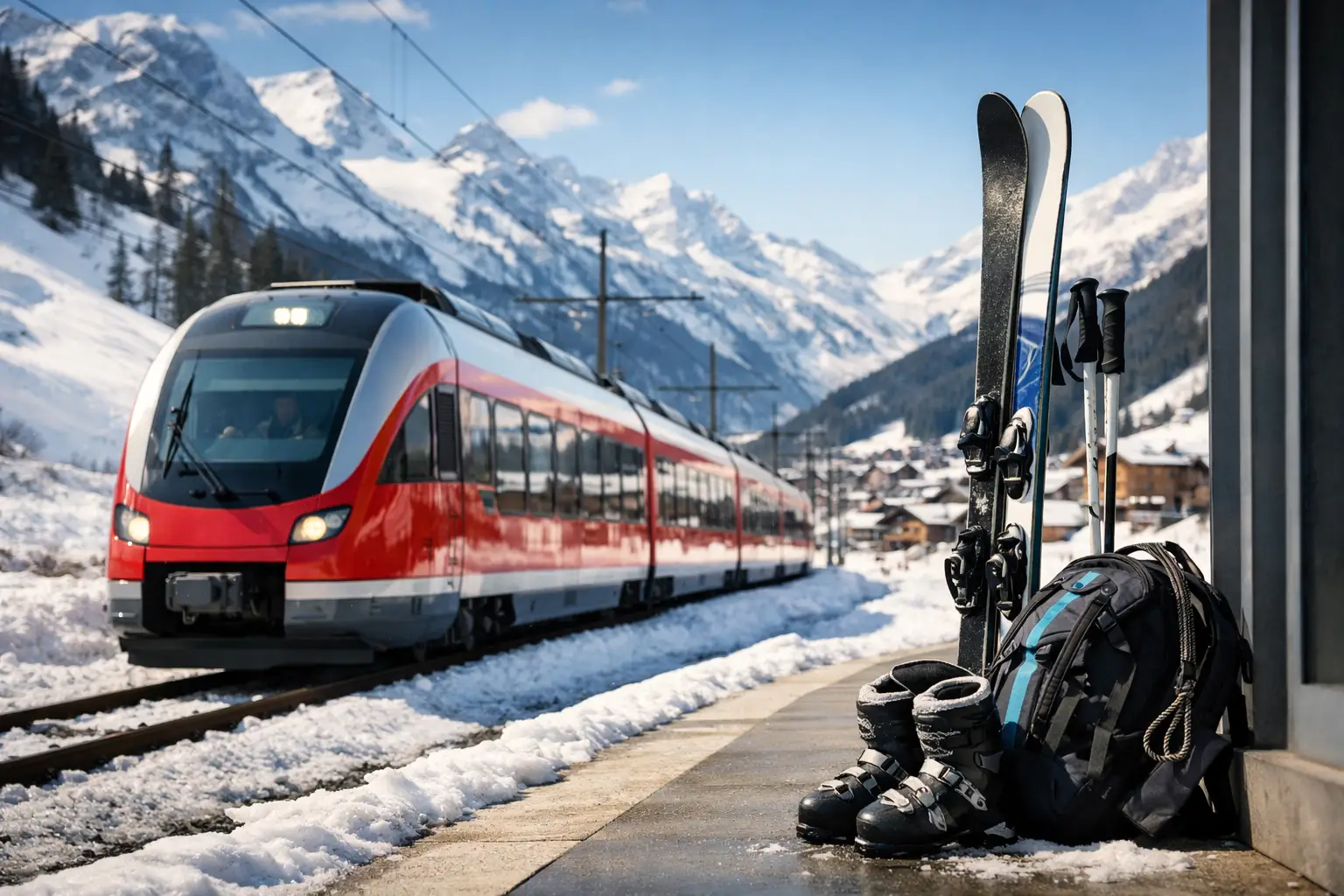
The old image of ski-train travel in Europe was a long, slightly clunky haul with too much platform waiting and not enough flexibility. That picture is changing. For UK skiers and snowboarders, rail is once again a serious option – not for every trip, and not for every resort, but for a growing number of mountain holidays where comfort, luggage allowance and lower-stress travel matter as much as speed.
If you have ever arrived in resort already tired from a 3am airport start, a train-based journey has obvious appeal. You get more personal space, fewer of the usual airline baggage calculations, and a travel day that can feel like part of the trip rather than a hurdle before it. The catch is that ski rail travel is only good when the route, transfer and resort pairing line up properly. Choose well and it is excellent. Choose badly and it can become a long day with too many changes.
Why ski train travel in Europe is back in the conversation
Part of the renewed interest is practical rather than romantic. More British skiers are thinking carefully about airport disruption, luggage costs and the hassle of moving ski bags through budget airline rules that seem to change by the season. Rail will not always beat flying on headline journey time, but it often wins on the overall experience.
There is also a better understanding now of which resorts work well by train. The strongest options tend to be big French resorts with straightforward transfer links from stations in the Tarentaise or Maurienne valleys, Swiss resorts with famously efficient public transport, and a handful of Austrian destinations where rail-to-resort connections are smoother than many people expect.
That matters because the real question is not whether train travel is possible. It is whether it is sensible for the particular week, group and mountain base you have in mind.
Which ski holidays suit train travel best?
The sweet spot is usually a one-week trip to a major resort with a simple final transfer. Families, couples and groups carrying lots of kit often get the biggest benefit, especially if they value arriving with less faff. Overnight travel can also make sense if it trims hotel costs en route or helps you wake up closer to the mountains.
Where ski-train travel in Europe works less well is on very short trips, especially three- or four-night breaks. If your priority is maximum slope time and minimum transit, flying can still be the better tool for the job. The same applies if your chosen resort is several bus legs beyond the nearest rail station or if your group includes very young children who will not tolerate a long multi-stage journey.
Snowboarders should also think about luggage practically. Rail is generally kinder to board bags than airlines, but changing trains with awkward kit is still awkward kit. One direct or near-direct route can feel brilliantly civilised. Three changes with lifts, stairs and busy stations can feel very different.
The best regions for ski-train travel in Europe
France remains the obvious place to start. Resorts such as Les Arcs, La Plagne, Tignes, Val d’Isere, Meribel and Courchevel all sit within reach of well-used rail gateways. Bourg-Saint-Maurice is the key name here. It is one of the most useful stations in Alps ski travel, with onward funicular, coach or taxi access to major resorts. Moutiers is another crucial arrival point for the Three Valleys and nearby areas.
The big advantage in France is concentration. A single valley station can open the door to several heavyweight ski areas, which makes rail planning more efficient and gives travellers more choice once they start comparing transfer times.
Switzerland is arguably the most polished rail nation for ski access. Resorts including Verbier, Wengen, Grindelwald, Zermatt and St Moritz fit naturally into a public transport network that feels built with mountain travel in mind. Journeys can be expensive, but they are often impressively smooth. If you want train travel to feel fully integrated rather than improvised, Switzerland is hard to beat.
Austria is a more mixed picture, but still promising. St Anton is one of the standout examples because the station is right in the resort, which removes one of the biggest pain points in ski travel – the final transfer. Other Austrian destinations can work well too, though the last leg sometimes matters more than the long international train itself.
How the journey usually works from the UK
For most UK travellers, the trip starts with Eurostar to Paris or Lille, then an onward high-speed or international connection deeper into the Alps. That sounds simple on paper, but the quality of the experience depends heavily on timing, station changes and connection margins.
Paris is often the sticking point. If your route requires changing stations within the city, you need to treat that transfer seriously, particularly with ski bags. It is manageable, but it is not something to underestimate after an early departure from London. Routes that avoid a fiddly cross-Paris change instantly become more attractive.
Booking windows and ticket release dates can also shape what is realistic. Rail fares reward early planning more than many ski holidaymakers are used to. Leave it too late and the price advantage can fade, especially during school holidays. Flexibility on departure day helps, and so does booking accommodation that matches your arrival station cleanly.
What train does better than flying
The biggest win is often comfort. You can stand up, move around, read, work, eat something decent and avoid the compressed feeling that comes with short-haul flying. For older skiers, families and anyone carrying boots, helmets and outerwear, this is not a minor detail.
Baggage is another area where rail makes a strong case. Skiers know the ritual of weighing bags at home and wondering whether one extra mid-layer will trigger a charge. Train travel is generally less punitive. That does not mean limitless luggage is wise, but it gives winter travellers more breathing room.
There is also the question of reliability in winter. Flights can be delayed for all sorts of reasons, and snowbound airports are never quite as romantic as they sound. Trains are not immune to disruption, but a rail-based journey can feel less brittle than an itinerary built around strict baggage cut-offs, security queues and transfer coach deadlines.
Where train travel can still fall short
Price is the obvious issue. If you book late, travel in peak weeks or need highly specific timings, rail can cost more than a flight. It can still be worth it, but the economics are not always as clear-cut as some would like.
Journey time is the second. For travellers from the South East, rail can be pleasantly competitive on some routes. For anyone starting in the North, South West or Scotland, getting to London may add enough extra travel to change the calculation completely. In those cases, the airport may simply be the more practical gateway.
The final resort transfer is the third and arguably the most important. A well-timed train to a valley station is one thing. A crowded bus, a long taxi queue or a late-night haul up a mountain road is another. Always judge the whole chain, not just the glamorous rail section.
How to make ski train travel in Europe work better
The smartest approach is to plan from the resort backwards. Start with resorts that are known to be rail-friendly, then look at station access, transfer duration and arrival times before falling in love with a fare. This avoids the common mistake of finding a good train deal and only later realising the last leg is awkward.
Travelling light helps, but travelling sensibly matters more. Keep ski boots and essentials easy to reach, and do not assume every station change will be smooth. Build in proper connection time, especially if changing in Paris or navigating unfamiliar platforms with winter kit.
It is also worth being realistic about your group. A pair of experienced adult travellers can handle a tighter itinerary than a family with children and multiple bags. Rail rewards calm planning, not optimistic guesswork.
For many readers of Skier & Snowboarder, the best case for train travel is not ideological. It is practical. If you can leave the car at home, avoid airport hassle, carry your kit with less grief and roll into a resort station or short transfer hub in reasonable comfort, that is a strong start to a ski week.
The smartest way to think about ski-train travel in Europe is as a very good option rather than a universal answer. Match it to the right resort, the right week and the right travel group, and it can transform the feel of the holiday before you even click into your bindings.