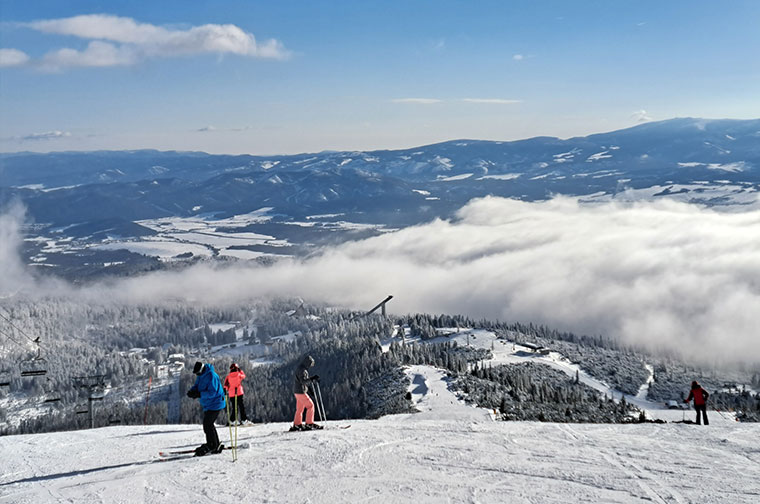
Ramy James Salameh discovers a nature-rich hidden gem in the Tatra Mountains, offering a contented and cosy stay on a ski trip that won’t break the bank.
Anticipation to ski in the Tatra Mountains began before I had even touched down.
This compact region of snowcapped peaks made for some early Instagram-worthy snaps from our Wizzair flight, as we approached Poprad-Tatry Airport from London-Luton after only a one-hour-and-50-minute flight.
Just 15 minutes after stepping out of the airport arrivals, we found ourselves checking into the enchanting Grandhotel Praha. This heritage gem, nestled next to Tatranska Lomnica Ski Resort, offers easy connections to Poprad city, Stary Smokovec – the Tatras’ oldest settlement – and Strbske Pleso ski resort via an electric railway. It was here, amid the beauty of Slovakia’s hidden winter paradise, that the words ‘compact’, ‘cosy’ and ‘contented’ became our rallying cry throughout the ski trip.
The hotel’s cheerful yellow facade and art nouveau interiors justified its name. Established in 1905, it once lured glamorous summer guests seeking health and wellness, a tradition that continues today with winter sports gaining similar popularity.
Still, few are aware of these elegant resorts and the affordability of skiing here – stays at select regional accommodations like Grandhotel Praha include a ski pass valid for multiple areas, as well as access to dedicated top-tier spas.
The Tatra region sits on geothermal reservoirs, with mineral-rich therapeutic waters bubbling up from depths of 2,500 metres, creating the perfect tonic after a day on the slopes, complimented by a traditional sauna ceremony.
Initiating my ski journey with Tatranska’s local ski school proved wise. Despite snatched lessons in quirky locations like Pyeongchang and Ski Dubai, it was with Dana, my instructor, in the Tatras that my rhythm and technique started to click.
I also suspect it was more than a good ski teacher which had me getting unnervingly close to parallel skiing. Each ski resort we visited felt relatively calm, but still had enough of a ‘buzz’ across the slopes. The pistes were wide, open and appealing and connected directly to traditional alpine-style villages offering plenty of character. All of which seemed to sync with my level of skiing.
Even when we skied in Jasna, the country’s largest ski area, host of several FIS World Cup races and capable of accommodating up to 15,000 skiers per day, it still seemed unhurried and relaxed, with a wait for a lift taking under 10 minutes.
Jasna is the home resort of Petra Vlhova – a Slalom Olympic gold-medallist whose face appeared on many screens and billboards as the nation’s number one sporting ambassador – but could a little of her stardust rub off on my skiing? Within Jasna’s 51km of slopes, there are myriad ‘blue’ routes; the first a modest gradient, was arrow straight and instantly built up my confidence, before attempting other higher-altitude routes.
Our group’s more advanced skiers were more than satisfied by their challenges. If we had been staying in Jasna they would have tried ‘Fresh Tracks’ – an opportunity to be on the slopes before the lifts officially open to the public and experience the perfectly groomed slopes before anyone else. The cost of this experience includes a hearty breakfast at the 2,004m-located Rotunda Panorama Restaurant looking out upon the summit of Mt. Chopok.
With Jasna no more than a 45-minute drive from our hotel, it was well-worth ticking it off the list, especially if looking for a resort with more ‘apres-ski’ experiences – think mid-station DJs or the end of season ‘bikini ski run’ as just part of the vibe, but certainly not all.
However, for me, the cosier resorts of Tatranska Lomnica, Strbske Pleso and Stary Smokovec were perfectly suited to beginners (like me), offering plenty for families too, without neglecting more advanced skiers.
During our stay in Strbske Pleso, the snow never stopped falling. A little extra elevation makes all the difference. The resort had a Lapland-like magic, anchored by its striking glacial lake, a uniquely designed observation tower beside the cross-country training tracks, and a ski jump. Strbske Pleso has hosted various FIS World Cups in Nordic disciplines and several Winter Universiades.
Cross-country trails radiate like tentacles from the lake, and a stamina-testing discipline I had to try with another lesson, this time with former athlete Michal Serfel who guided us through the powdery white landscape.
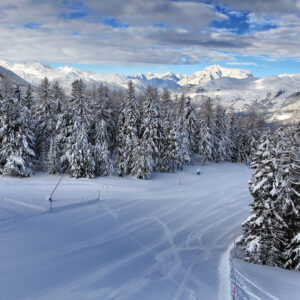
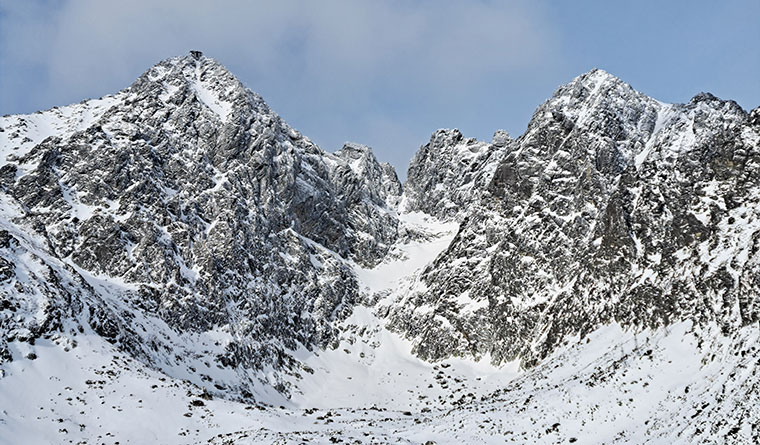
Of the three resorts, Tatranska Lomnica brought me the most joy. Wide, snowy boulevards weave through evergreen forests, keeping me happily occupied before lunch, located well above the tree line at the Panorama Restaurant. Perched at 1,750m, Skalnate Pleso station is reached via two heated chairlifts – our reward was a life-affirming sense of drama above the clouds, watching the snowy world unfurl beneath you, especially when looking up at the granite faces of Lomnicky and Kezmarsky peaks.
Eating goulash with farmhouse bread, beside floor-to-ceiling windows whilst gazing down at the ribbons of skiers and even Poprad in the distance, is utterly magnetic.
I save the word breathtaking for the next gondola ascent, climbing from Skalnate Pleso to the summit of Lomnicky Peak. One needs a steady head for heights, as the small red gondola – among Europe’s steepest – makes an almost pylon-free leap to the top. From your 2,634m perch, distant snow-capped peaks and glacial tarns unfold below. The summit is more than a viewpoint, housing an Astro-Meteorological Observatory, a charming café, and even a cosy two-bed hotel with a true bucket-list “room with a view”.
No matter the season, securing a pre-booked spot on this unique gondola requires speed, but whatever the cost, it’s worth it. Just below the summit, at 2,190m, adrenaline-seekers can tackle Slovakia’s longest ski run, a 6.5km descent plunging all the way to the village of Tatranska Lomnica.
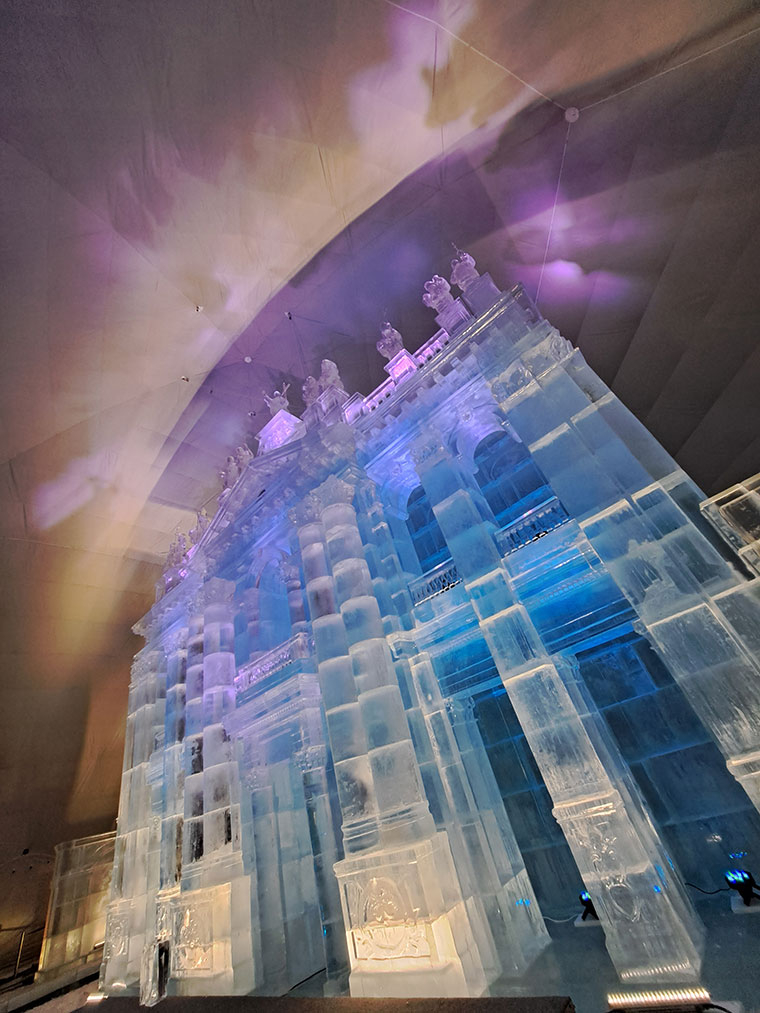
Whilst we did not ski in Stary Smokovec, it is a gateway to exploring culture, nature and heritage. We took the funicular from Stary Smokovec to Hrebienok, in search of the Tatra Ice Temple, an annual attraction made from 225 tonnes of ice and 1,800 ice blocks, this year depicting the ‘Basilica of Saint John Lateran’ in Rome. A short hike away is ‘Bilkova Chata’, a fairytale wooden chalet draped in fairy lights and the ideal spot to warm-up with one of the region’s most popular mountain liqueurs.
The more adventurous can follow in the footsteps of ‘the last sherpas of Europe’ towards more elevated mountain huts, some as high as 2,250m. Equipped with skis, crampons and their special framed back-packs called ‘Krosna’, the sherpas are loaded with up to 100kg of food and fuel, as they navigate treacherous yet stunning terrain, passing waterfalls and dramatic snow-filled scenery.
A novel way to return to Strbske village is by sledge, racing down the country’s longest toboggan run, floodlit after dark. Squeals of delight echoed across the slopes, even reaching us on the funicular, which runs parallel along parts of the descent. Back in the village, with appetites thoroughly earned, a table awaited us at Koliba restaurant. Here, rustic regional dishes offer a glimpse into the mountain cuisine that has sustained life here for centuries, from ‘Bryndzove Halusky’, potato dumplings with sheep’s cheese and bacon to ‘Kapustnica’, a hearty sauerkraut soup.
Our hotel was only a short drive away, once again highlighting how compact and easy to navigate the Tatras are, and how cosy each snow-enveloped village feels, yet curating a ski-vacation which did not break the bank; another reason which contributed to a deeply contented stay. I’m certain to return, aiming for a few ‘red-runs’ and plenty more adjectives to describe Slovakia’s nature-rich hidden gem.
For more information, visit Regiontatry.sk & Visitliptov.sk