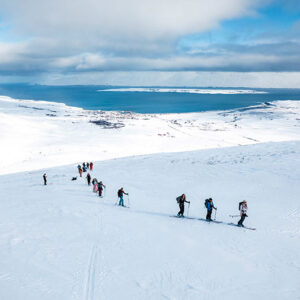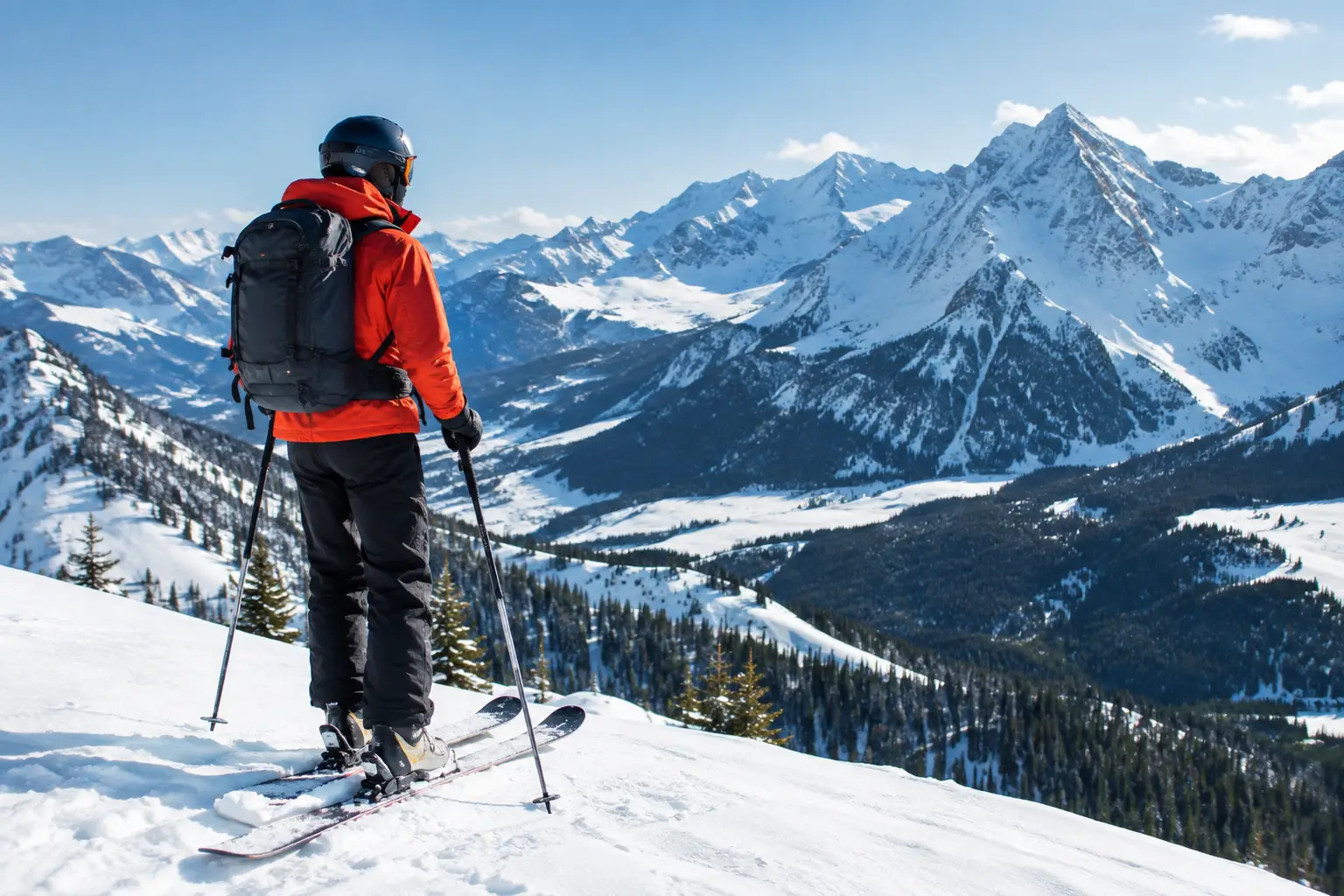
A skin track can make the mountains look deceptively orderly. There may be a neat line of people climbing above the lifts, a bluebird forecast and a café visible far below. Yet ski touring risks begin well before the snow becomes steep enough to feel serious. A minor route-finding error, a change in wind, an overconfident pace or a poorly understood snowpack can turn an ambitious day into a difficult one.
For UK skiers and snowboarders, touring often starts on a holiday where time is limited and the urge to make the most of fresh snow is understandable. That is precisely why judgement matters. Touring offers quiet, freedom and access to remarkable terrain, but it asks more of you than a lift-served powder lap. The aim is not to avoid every risk – that is impossible in the mountains – but to recognise what is changing, make conservative choices early and retain enough margin to get home safely.
Ski touring risks are rarely just about avalanches
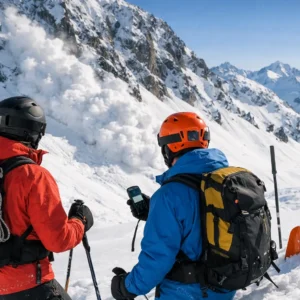
Avalanches deserve their central place in any discussion of ski touring. They are often the most consequential hazard, and understanding avalanche terrain, snow stability and the effect of recent weather is fundamental. But focusing solely on avalanches can create a false sense that a transceiver, probe and shovel are the whole safety plan.
A touring day is a chain of decisions. Cold injury, hidden crevasses, cornices, cliffs, poor visibility, tree wells, stream crossings, equipment failures and simple exhaustion all carry consequences. In popular terrain, another party’s tracks are not evidence that a slope is safe. They may have travelled before fresh wind loading, chosen a different line, or simply accepted a level of exposure that does not suit your group.
The most useful mindset is to assess the whole day rather than one steep descent. Consider the approach, the ascent track, the summit ridge, transitions, escape options, the forecast temperature change and the journey back to the valley. A modestly angled run can still require travelling beneath avalanche paths or negotiating a confusing glacier exit in flat light.
The terrain is the first filter
Before worrying about whether a particular slope will avalanche, establish what happens if it does. Terrain dictates consequence. Slopes in the classic avalanche angle range, roughly 30 to 45 degrees, demand particular attention, especially where they funnel into gullies, finish above cliffs or run into dense trees.
It is equally important to look above and alongside your intended line. A safe-looking skin track can cross beneath loaded slopes. A broad summit ridge may have cornices extending much farther than expected. In spring, a descent that feels straightforward at midday can be threatened by wet snow releasing from sunny slopes above.
Good route selection builds in alternatives. If visibility closes in, is there a simpler descent? If a slope feels wrong, can you turn around without entering more consequential terrain? If the answer is no, the plan may be committing too much before the group has gathered enough information.
Snow and weather can change the plan quickly
Mountain forecasts are a starting point, not a guarantee. Wind is particularly influential because it moves snow rapidly, building unstable deposits on leeward slopes even when there has been little new snowfall in the village. A clear morning can also conceal a weak layer buried during an earlier storm cycle.
Pay attention from the moment you leave the piste boundary. Recent avalanches, cracking around skis, hollow or drum-like snow, and sudden deposits of wind-blown snow are all warning signs. None should be treated as a puzzle to solve on the slope. They are reasons to step back, reduce exposure and reconsider the objective.
Spring brings a different rhythm. Overnight refreezing can create a short window of supportive snow, followed by a rapid softening as the sun gains strength. Timing is then as important as location. Starting too late may mean breaking through crust on the climb and skiing increasingly heavy, wet snow on the way down. Starting too early can leave hard, consequential surfaces where a slip is difficult to arrest.
Local avalanche bulletins, lift patrol information and guide advice are valuable because they add regional context that a general weather app cannot provide. Read the bulletin properly, including its aspect and altitude details, rather than reducing it to a single danger number. A moderate rating does not mean every slope is moderate; it often means the problem is specific and requires accurate terrain choices.
Navigation and visibility are serious ski touring risks
Modern mapping and phone navigation are useful, but batteries fade in cold weather, screens are hard to read in snowfall and an electronic line cannot judge snow conditions for you. Carry a proper map, compass and the knowledge to use them, alongside an offline mapping device and a power bank protected from the cold.
Whiteout deserves respect. In flat light, rolls in the terrain disappear, crevasse bridges become harder to identify and a familiar descent can feel entirely different. This is especially relevant for British visitors touring on glaciated terrain in the Alps, where a summer walking route or a line shown on a map may not be appropriate in winter.
Glacier travel is a specialist subject, not an extension of ordinary off-piste skiing. Crevasses can be hidden by thin snow bridges, and travelling roped requires training, judgement and practised rescue systems. If the route crosses a glacier, a qualified guide is often the sensible choice unless every member of the group has the relevant skills and experience.
Equipment helps only when the team can use it
Avalanche transceiver, probe and shovel are standard equipment for touring in avalanche terrain, carried by every person rather than shared around the group. They must be complemented by regular practice. A transceiver search in a warm car park is better than none, but it does not replicate stress, deep snow, gloves, uneven terrain or the urgency of a real burial.
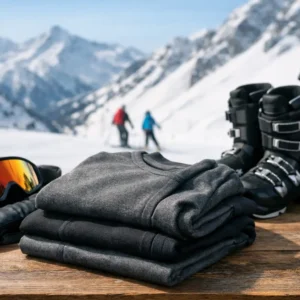
Your kit should suit the route and conditions. That may include crampons, ice axe, helmet, ski crampons, a repair kit, spare layers, headtorch, first-aid supplies, emergency shelter, food and water. Carrying more equipment has a trade-off: a heavy pack slows the ascent and contributes to fatigue. The answer is not to leave essentials behind, but to choose a realistic objective and organise the pack so key items are accessible.
Do not overlook touring-specific mechanical issues. Skins can lose adhesion, bindings can ice up, boots can cause painful pressure points and poles can fail. On a cold or windy day, a ten-minute repair stop can quickly become an exposure problem. Check kit at home, carry spares appropriate to your setup and learn the basic fixes before travelling.
Group decisions can be the decisive hazard
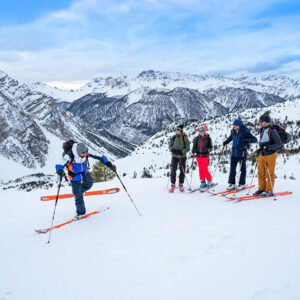
Strong skiers are not automatically strong touring partners. A group needs compatible fitness, technical ability, appetite for risk and willingness to speak up. One person racing ahead, another struggling to keep warm and a third quietly uncomfortable with the route is a familiar recipe for poor decisions.
Set expectations at the start. Agree the objective, turnaround time, spacing on exposed slopes and who will make the final call if conditions deteriorate. Encourage anyone to voice concern without needing to justify it perfectly. A vague feeling that the snow or terrain is wrong is worth investigating, particularly when it comes from someone who is not invested in pushing for the summit.
Human factors matter because powder, blue skies and social momentum all make retreat emotionally difficult. Tracks ahead, expensive lift passes and a long-awaited holiday can add pressure. The most experienced touring groups are not those that always complete the plan. They are the ones that can change it without drama.
Build experience in layers
The safest route into touring is gradual. Start with controlled uphill routes, low-angle terrain and days with stable, well-understood conditions. Take an avalanche course relevant to the country and terrain you will use, then practise the skills repeatedly. A ski touring guide or instructor can accelerate learning by explaining the observations and choices that are easy to miss when following friends.
There is no shame in hiring a guide for a bigger objective, a first glacier crossing or a complicated weather window. It can be the best way to enjoy a classic route while learning how professionals manage pace, terrain and changing conditions. Likewise, staying within a resort’s patrolled boundaries remains an excellent choice when the forecast, snowpack or group experience does not line up.
The reward of ski touring is not simply reaching untouched snow. It is learning to move thoughtfully through winter mountains, accepting that the best call may be a shorter route, a lower slope or an early return for coffee. Those are not wasted days. They are the habits that keep the next touring day possible.