Frank ‘Scoop’ Baldwin looks at the effect Ski Sunday being axed could have on the UK ski industry.
For generations, Ski Sunday was far more than a programme about ski racing. It was a weekly shop window for the mountains – and, crucially, it reached an audience vastly larger than the number of people who actually went skiing.
Therefore, the announcement that Ski Sunday is being axed after almost 50 years is sad news for the UK ski industry. The primary reasons given by the BBC is that the programme is another casualty of changing viewing habits and required cost-cutting.
At its peak, Ski Sunday attracted 4.5 million viewers, according to evidence given to Parliament in 1996, while a BBC annual report from the 1980s recorded audiences of up to six million for its World Skiing Championship coverage.
The UK ski and snowboard market has traditionally been estimated at around one million people travelling abroad to ski or snowboard each year. Therefore, at its peak, Ski Sunday was reaching several times the size of the actual UK skiing and snowboarding population.
That is what made the programme so valuable. Its audience wasn’t simply made up of committed skiers. Millions of people who had never strapped on a pair of skis could sit down on a Sunday afternoon or evening and see the spectacular scenery of the Alps, the excitement of downhill racing, the glamour of resorts and, increasingly, the thrills of snowboarding and freestyle skiing.
For some viewers it was entertainment. For others it was inspirational. And for quite a few it may have been the programme that planted the seed for their first ski holiday.
TV presenter David Vine became famous for fronting Ski Sunday from 1976-1996 when ‘Pop Looks Bach’ began its journey to becoming one of the most iconic and recognised theme tunes.
Hazel Irvine then briefly stepped in before British ski racer Graham Bell and snowboarder Ed Leigh took over as co presenters until 2021 when ski racer Chemmy Alcott took over from Graham.
One of the issues the early days of Ski Sunday faced is that, even with the advances in better cameras, it was not always possible to capture the dangerous speeds at which racers hurtle downhill and just how steep the race courses are.
Graham, who took his first steps into the media world by writing monthly features for the Skier & Snowboarder magazine in 1989 when I became editor, helped bring the racer’s experience alive by skiing the courses himself with a handheld camera.
During the descent he would explain what challenges the racers faced and how much their legs would be screaming with pain as they headed towards the finish line, because of the high metabolic demand and lactate accumulation.
Graham and Ed also helped highlight other activities available in ski resorts which again acted as a great promotion for ski holidays.
Ski Sunday viewing figures
There is a danger in judging Ski Sunday purely by today’s television ratings. Before the programme was axed, its audience had fallen to around one million viewers, according to reports earlier this year. That is a huge decline from its 1980s heyday, and seems to back up the BBC’s argument about changing viewing habits.
However, one million viewers is still a substantial audience for a specialist winter sports programme. And the important point is that the programme’s influence cannot necessarily be measured by the number of people watching who already ski.
Co-presenters Chemmy Alcott and Ed Leigh have described how Ski Sunday was a family affair when they were growing up with everyone gathering in front of the TV to watch it every week during the ski season.
This is perhaps the real legacy of Ski Sunday. It made skiing – and later snowboarding – look accessible, exciting and desirable. The pictures of sunshine, blue skies, snow-covered mountains and skiers racing down spectacular pistes provided an extraordinarily effective advertisement for the ski holiday – even though that was never originally the programme’s purpose.
The BBC says it remains committed to winter sports, particularly the Winter Olympics, across its platforms. But there is a significant difference between occasional Olympic coverage and having a regular programme throughout the winter that keeps skiing and snowboarding in front of the public.
And that matters because skiing is not football. It does not have millions of regular participants in Britain. It needs to attract people who have never tried it, persuade lapsed skiers to return and continually remind existing skiers that another winter in the mountains is approaching.
The irony is that Ski Sunday may have become a victim of the very changes it helped create. Today’s skiing audience has an extraordinary choice of online video, specialist television, social media and live coverage.
The challenge now is ensuring that the millions of people who don’t actively seek out skiing content continue to see it.
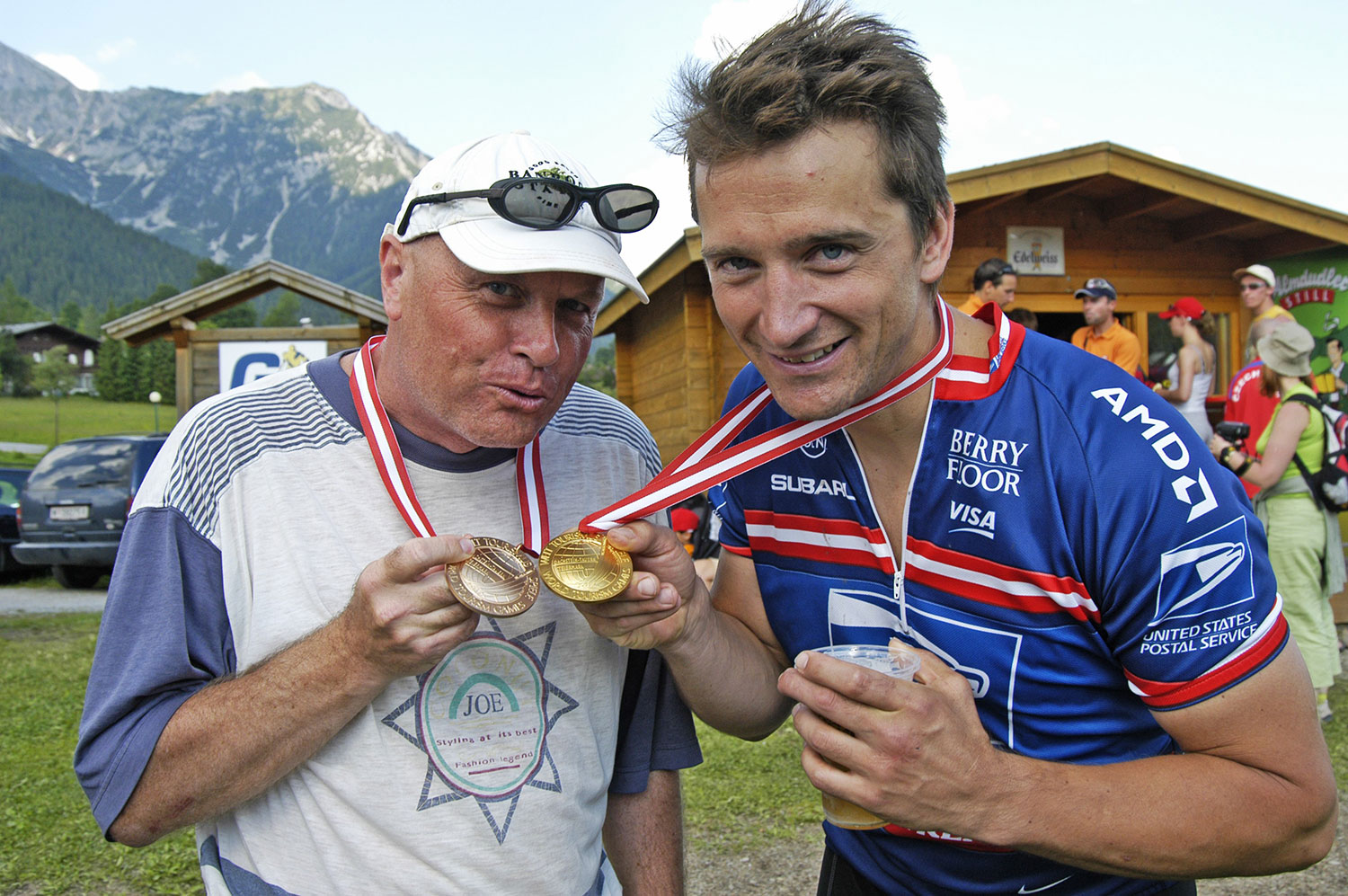
Image: Former Skier & Snowboarder magazine editor Frank ‘Scoop’ Baldwin with Ski Sunday presenter and British racer Graham Bell when they were team mates at the World Tourism Games in Austria – and both won medals!